11. The burgundy curly bob with ruby streaks
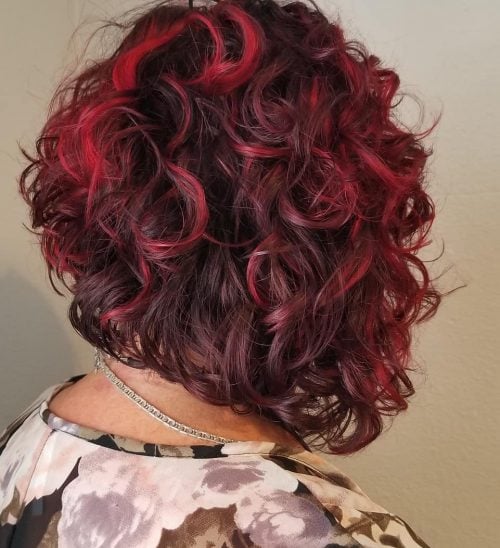
Not ready for a full fade? This curly bob layers bright ruby streaks over a deep burgundy base instead. The red pieces are concentrated on the top layer and the ends, so they look brightest where light hits the curls. The bob is cut longer in front and shorter at the nape, which lets the curls fan out at the back.
- Best for: Medium curls in a bob length; anyone who likes deep, wine-colored hair.
- Ask your stylist for: A burgundy base with bright red streaks on the top and ends, on an angled curly bob.
- How to style it: Rake in a curl cream, scrunch and diffuse for volume at the back.
- Upkeep: Gloss every 4 to 6 weeks; trim every 8 weeks.
Purple, pink and rainbow curls
Vivid colors look richer on curls because the texture adds shadow and highlight to every shade. These three go bright.
12. The rainbow spiral blend
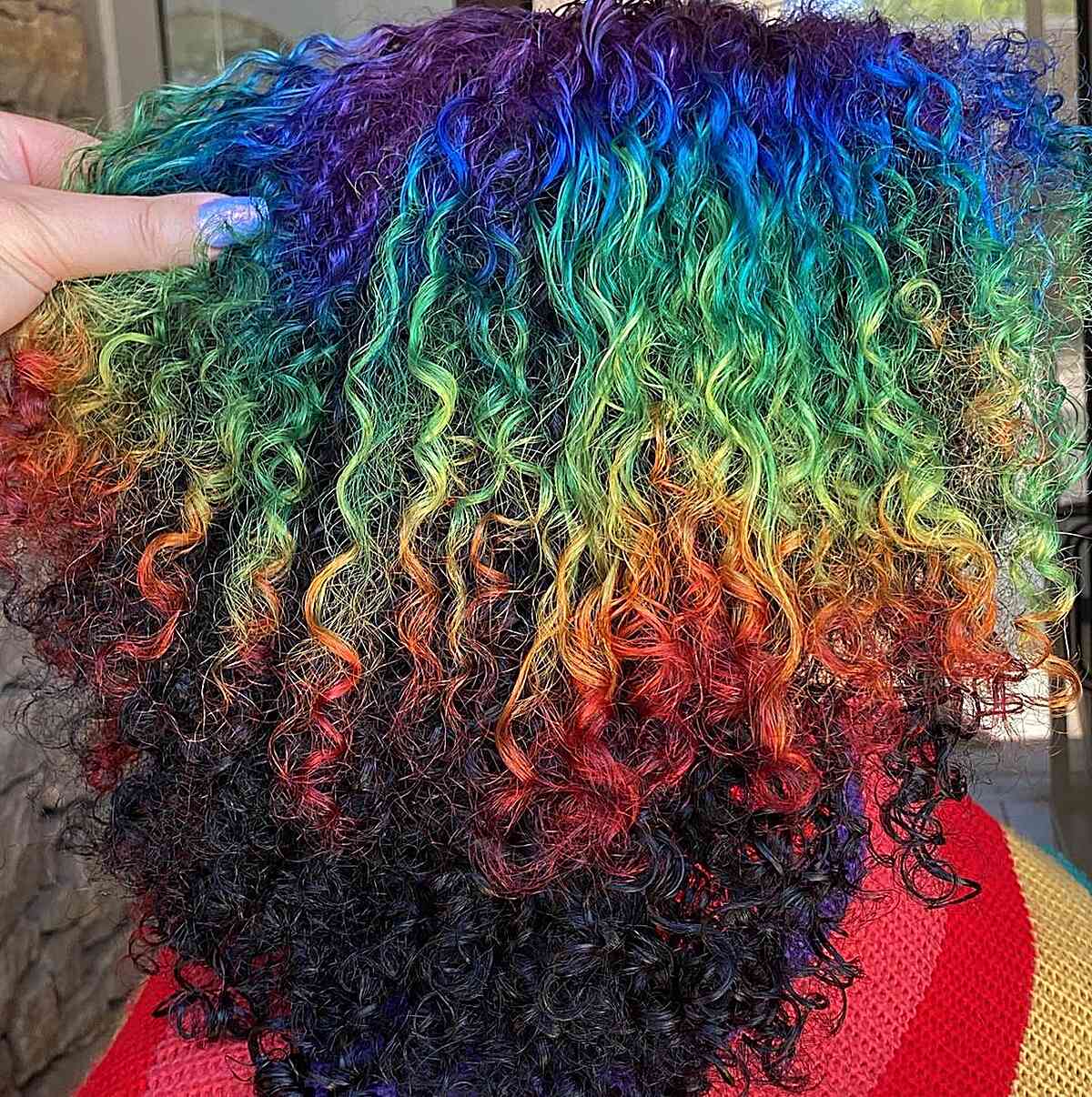
Go all in. Tight curls carry a full rainbow, with purple and blue at the crown, green and yellow through the middle and orange and red toward the lower curls, before the very ends darken back to black. The shades run in horizontal bands, so the color changes as your eye travels down. Curls blur the edges between each band.
- Best for: Thick, healthy curls already lightened through the top.
- Ask your stylist for: A horizontal rainbow placement from purple at the root to red, with dark ends, on a pale lifted base.
- How to style it: Apply gel in sections, diffuse and avoid heavy oils that dull vivid dye.
- Upkeep: Refresh every 4 weeks; wash in cold water with a sulfate-free shampoo. See our rainbow hair ideas for other placements.
13. The violet shoulder-length curls
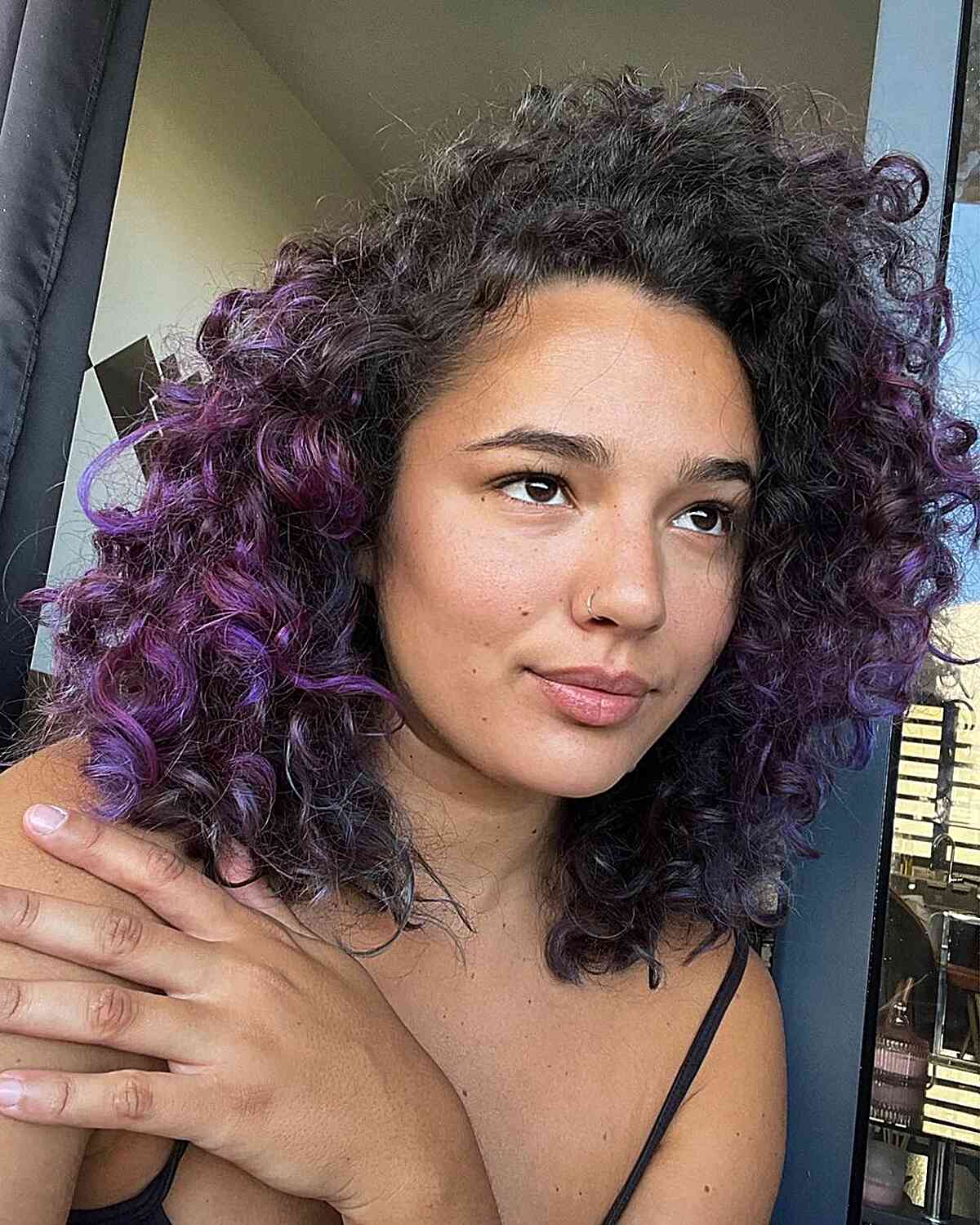
Purple fades into dark curls so naturally that this looks almost like it grew in that way. A near-black root sits through the crown, then shoulder-length curls deepen into violet and plum on the ends, brightest on the curls framing the face. The purple stays rich even in shade. A great first vivid, because the dark root does a lot of the work.
- Best for: Dark curls of any density; first-timers trying vivid color.
- Ask your stylist for: A dark-to-violet ombre from the cheekbones down, with a purple color-depositing gloss.
- How to style it: Apply leave-in and gel, scrunch and air-dry, then fluff the roots.
- Upkeep: Purple refresh every 4 to 6 weeks.
14. The magenta-tipped curly bob
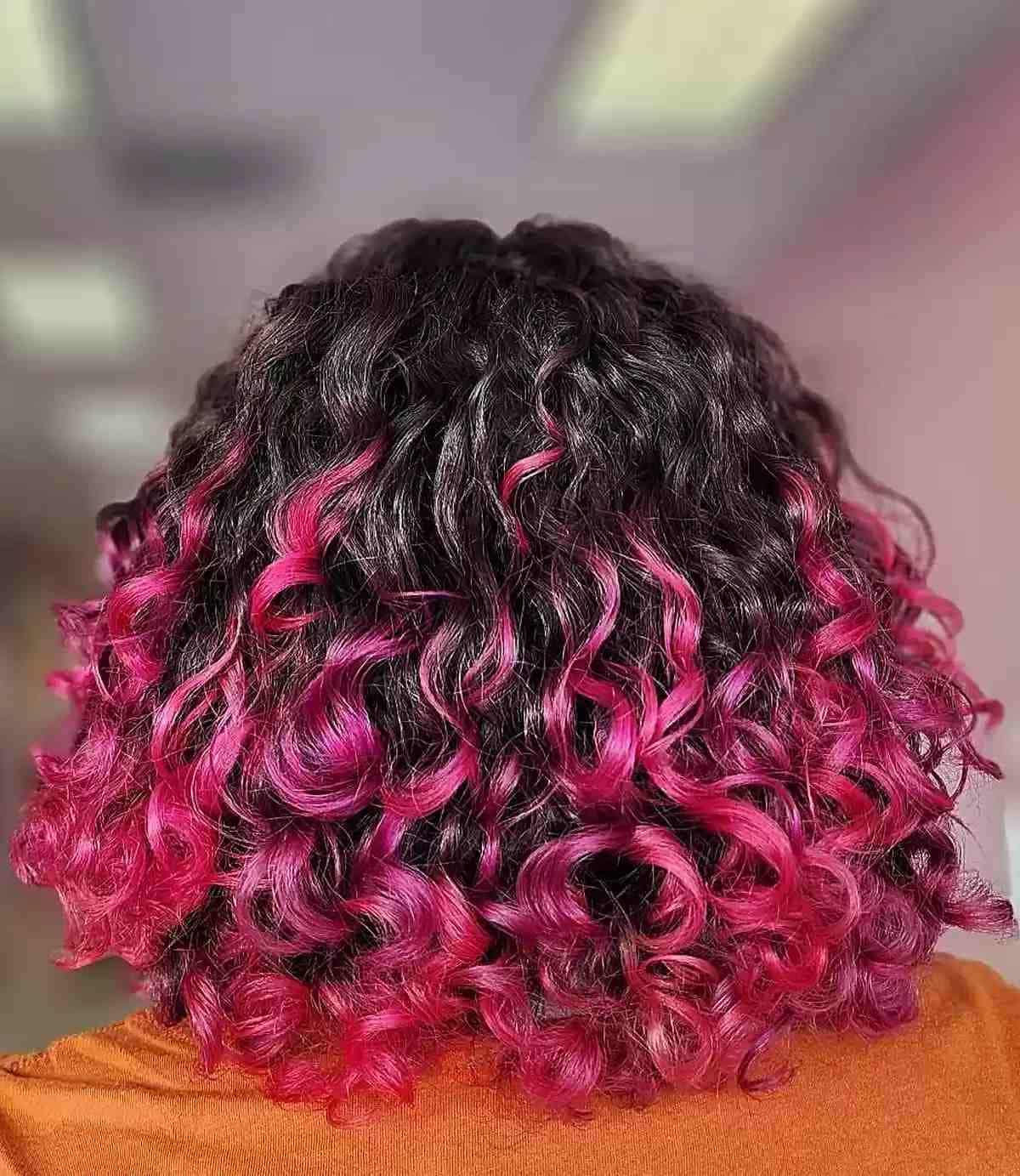
From behind, this curly bob looks like a dark rose in bloom. Dark brown roots fill the top half, and bright magenta takes over the lower curls, especially on the outer edges. The bob is cut round and full at chin to collarbone length. The fuchsia stays bright because it sits on lightened ends rather than over the dark root. More options in our pink ombre ideas.
- Best for: Medium to thick curls; anyone who wants a bright fade in a bob.
- Ask your stylist for: A dark-to-magenta ombre from the mid-lengths, on a rounded curly bob cut dry.
- How to style it: Diffuse on low heat for maximum volume, then shake out at the roots.
- Upkeep: Magenta refresh every 3 to 4 weeks; trim every 10 weeks.
Blue, teal and pastel curls
Cool tones sit beautifully on dark curls and fade with minimal brassiness when kept on the ends. Shapes range from long ringlets to short coils; for more short cuts, see our curly bob hairstyles.
15. The ocean blue ringlets with bangs
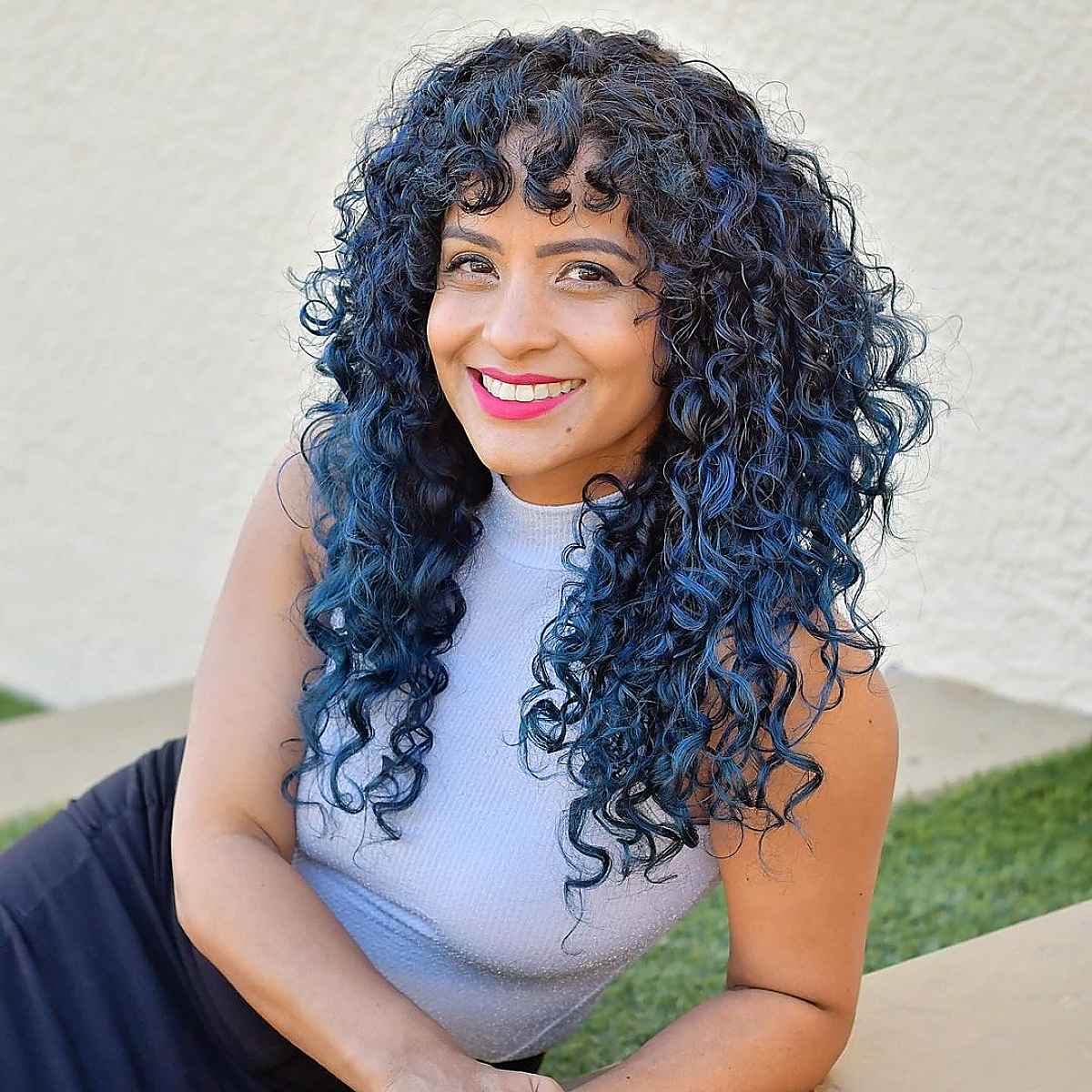
Love blue but want it to look grown-in? This long ringlet cut keeps the roots dark navy and lets bright ocean blue take over the lengths. Curly bangs fall onto the forehead and blend into long, layered ringlets past the shoulders. The darker root keeps the face framed and softens regrowth. Up close, lighter sky-blue strands mix into the brighter ringlets, so the color has depth rather than a flat, painted look.
- Best for: Long, defined ringlets with a dark base.
- Ask your stylist for: A navy root melting into bright blue lengths, with curly bangs and long layers cut dry.
- How to style it: Gel each section while soaking wet, then diffuse without touching.
- Upkeep: Blue refresh every 4 weeks; bang trims every 4 to 6 weeks.
16. The cobalt coily crown
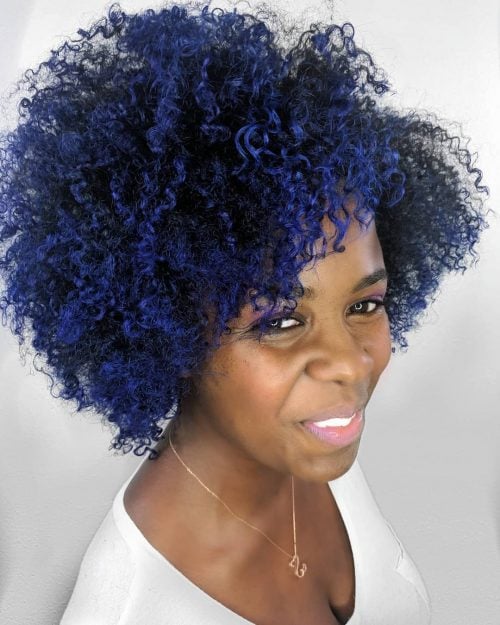
Short coils and cobalt blue are an unexpected and confident match. The hair is worn as a round, natural shape, with darker roots fading into vivid cobalt on the outer coils. Because tight coils are so dense, the color looks almost velvety. Keeping the blue off the scalp reduces lightening on the most fragile part of the hair. The front coils are the brightest, framing a smile with vivid color.
- Best for: Short, tight coils; anyone ready for a bold change.
- Ask your stylist for: A dark-to-cobalt ombre on the outer coils, with a bond-building treatment and a rounded shape.
- How to style it: Moisturize with a leave-in and a butter, then pick out the roots for shape.
- Upkeep: Blue refresh every 4 weeks; weekly deep conditioning.
17. The teal-ended long curls
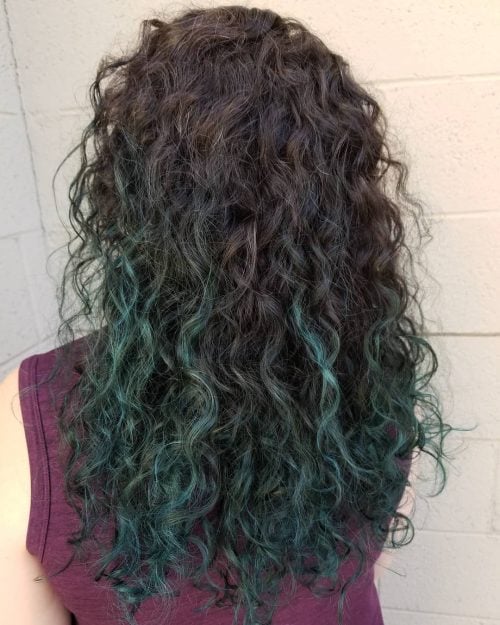
Subtle from far away, colorful up close. Long, loose dark brown curls fall past the shoulder blades, and teal begins around the shoulders before getting brighter at the ends. Because the teal sits on dark hair with minimal lightening, it looks smoky rather than neon. The lower curls are looser than the crown, so the teal stretches out in long spirals at the ends. Ideal if your workplace prefers low-key color.
- Best for: Long, loose curls with a dark brown base.
- Ask your stylist for: A soft teal ombre on the lower third, lightened minimally to keep the tone smoky.
- How to style it: Scrunch in a curl cream and air-dry, then refresh with water and leave-in on day two.
- Upkeep: Teal refresh every 4 to 6 weeks.
18. The lavender-silver ringlets
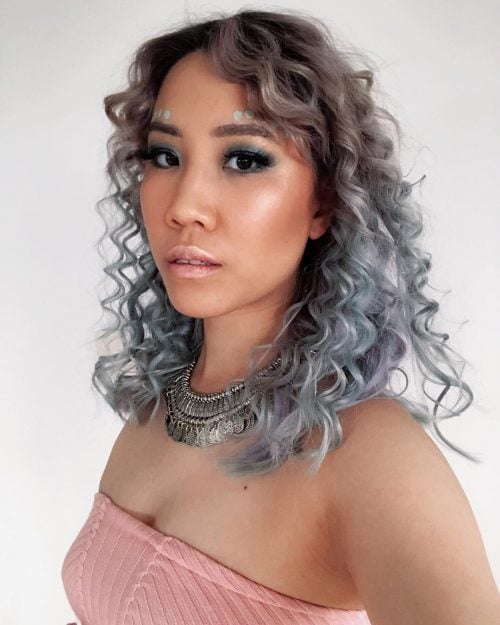
Pastel curls have a softness no straight hair can match. Here a dark root fades into smoky lavender and silver, and the shoulder-length ringlets catch both shades as they bend. The face-framing curls are lightest, so the color brightens around the face. Pastels need a very pale base, so this suits healthy, well-conditioned curls. A loose center part lets the darker root show as a soft shadow that keeps the pastel grounded.
- Best for: Healthy, defined curls that can be lifted to a pale level.
- Ask your stylist for: A dark root into smoky lavender and silver, with a bond-builder and a curly cut at shoulder length.
- How to style it: Use a purple-tinted conditioner, then gel and diffuse.
- Upkeep: Tone every 3 to 4 weeks; pastels fade fast.
19. The silver-to-ice blue spirals
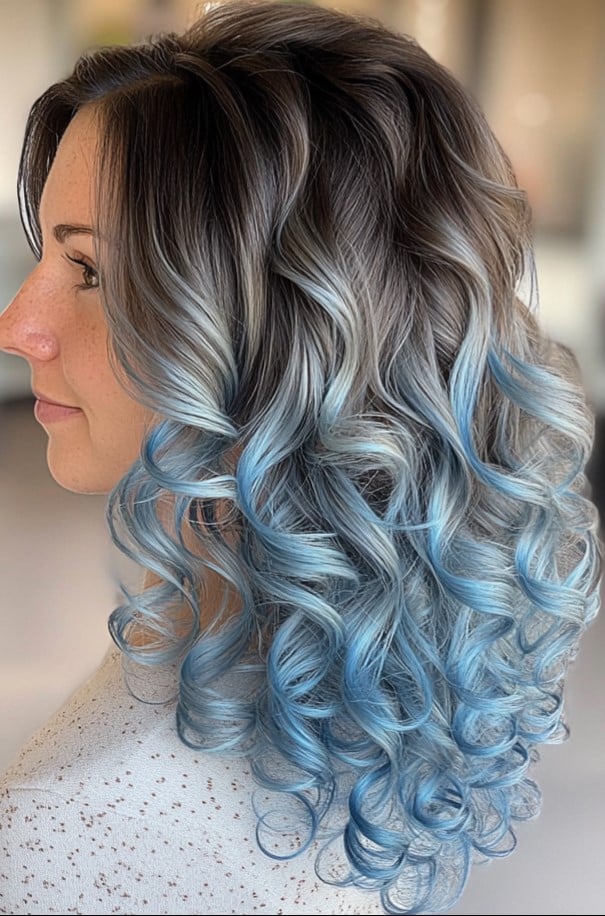
Frost at the ends, shadow at the root. This long spiral curl fade starts dark at the crown, moves through silver around the face and finishes in icy blue on the lower curls. The spiral curls make the colors overlap, so the transition looks liquid. Large, glossy spirals give the icy ends a polished finish. It’s a cool-toned alternative to a classic blonde fade.
- Best for: Medium curls already lifted at the ends; anyone who loves cool shades.
- Ask your stylist for: A dark root melting into silver and then icy blue on the ends, with a toner to keep the silver clean.
- How to style it: Wrap damp sections around your finger with gel, then diffuse.
- Upkeep: Silver and blue refresh every 3 to 4 weeks.
How to style ombre curls at home
For defined curls
- Wash with a sulfate-free shampoo and follow with a rich conditioner.
- On soaking wet hair, apply a leave-in conditioner and a curl cream.
- Glaze a gel over the top in sections to lock in definition.
- Diffuse on low heat or air-dry without touching.
- When fully dry, scrunch out the cast with a drop of oil on your hands.
For volume
- Diffuse upside down for the first half of drying.
- Clip the roots at the crown to lift them.
- Once dry, pick out the roots gently with a wide-tooth pick.
- Shake the curls out at the base for shape.
Caring for colored curls
Lightened curls lose moisture faster, so schedule a deep conditioning mask once a week and a bond-building treatment monthly. Wash in cool water two to three times a week at most, and use a color-depositing conditioner for vivid shades. Sleep on a satin pillowcase or in a pineapple to keep curls from frizzing. A curly trim every 10 to 12 weeks removes dry ends before they spread up the curl.
Because ombre keeps the root natural, you rarely need root touch-ups. When you want a change, the lightened ends can be cut out or glossed into a new shade. For shorter curly cuts, see our curly pixie cuts.
What to tell your colorist
- Your full color history, including box dye and henna.
- Where you want the fade to start: cheekbones, jaw or shoulders.
- Your curl pattern and how much shrinkage you get.
- Whether a bond-building treatment can be added to the lightener.
- How often you’re happy to come back for gloss or vivid refreshes.
Frequently asked questions
Is ombre damaging for curly hair?
Any lightening carries risk, but ombre keeps bleach off the roots and away from the scalp. Using a bond-builder and lightening slowly helps the curl pattern stay intact.
Where should an ombre start on curly hair?
Usually at the cheekbones or jaw. Curls shrink, so the fade should start a little lower than it would on straight hair, and it should be placed on dry curls.
How is ombre different from balayage on curls?
Ombre lightens the ends evenly into a fade from dark to light. Balayage hand-paints pieces through the curls for a scattered, sun-kissed effect.
How long does a vivid ombre last on curly hair?
Vivid shades usually last three to six weeks. Curly hair is often more porous, so cool water, fewer washes and color-depositing conditioners help.
For more curly hair ideas, see our curly shag lob haircuts, long ombre hair ideas, short ombre hair ideas and black ombre hairstyles.