
Move your part to the center and a bob changes character. The same blunt line that looks playful with a deep side sweep turns calm and symmetrical, with both sides falling in matching curtains that frame the face like a pair of brackets. It is one of the simplest changes you can make in front of the mirror, and one of the most noticeable.
We picked 10 middle part bobs that show how much range that single parting has: glassy platinum cuts that end at the jaw, rooted blondes that grow out softly, beige and honey long bobs that skim the collarbone, and dark brunette and jet-black versions with face-framing layers. If you prefer your hair swept to one side, our side-parted bob haircuts make a useful comparison. For every look below you’ll find who it suits, what to ask for in the salon, how to style it at home and how often you’ll need a trim.
How to choose a middle part bob
A center part splits your hair into two equal halves, so it shows off the evenness of the cut more than any other parting. The perimeter needs to be level on both sides, and the length decides whether the look reads crisp and graphic or soft and relaxed.
| Hair type | Middle part bobs that work best | What to avoid |
|---|---|---|
| Fine or thin | A blunt jaw-length bob with a solid perimeter, so the ends look thick on both sides of the part | Heavy face-framing layers, which leave the front looking see-through |
| Thick | A collarbone-length bob with internal weight removal and ends that curve under | A short one-length bob with no thinning, which puffs out into a triangle |
| Wavy | A shoulder-grazing bob with long face-framing pieces that let the wave fall away from the part | A very short blunt line that forces daily flat-ironing |
| Straight | A sleek blunt or slightly A-line bob, chin to collarbone length | A part that is cut off-center, which shows as uneven lengths |
| Cowlick at the front hairline | A longer bob with curtain-style front pieces that weigh the part down | Very short front sections that spring up at the root |
Length: a jaw-length middle part bob is the most graphic version and needs regular trims to stay level. A collarbone-length cut is more forgiving and can be tucked, waved or worn sleek. Color: a center part draws the eye straight to your roots, so a soft shadow root, like the ones in our shadow root blonde ideas, makes regrowth far less obvious than a hard line.
Sleek blonde and platinum middle part bobs
Light colors show every millimeter of the cut, which is exactly why they suit a center part. These four keep the lengths glassy and let the symmetry do the work; for more pale shades, see our blonde bob haircuts.
1. The butter blonde jaw grazer

Throw on sunglasses and a leather jacket and this bob looks finished before you’ve done anything else. Warm butter blonde starts a shade deeper at the part and brightens toward the ends, which stop just below the jaw in one clean line. Both sides fall straight and close to the cheeks, then turn under by the smallest degree at the tips. That slight inward bend is what keeps a blunt perimeter from looking hard. Polished, but not precious.
- Best for: Straight, fine to medium hair; anyone who likes a crisp, graphic shape.
- Ask your stylist for: A jaw-length blunt bob cut level on both sides of a center part, with the ends beveled under very slightly.
- How to style it: Blow-dry with a paddle brush, pointing the nozzle down the shaft, then run a flat iron through and curve the last half-inch inward.
- Upkeep: Trim every 5 to 6 weeks to keep the line level; tone every 6 to 8 weeks.
2. The icy curtain over one eye

Want a little mystery without changing your part? Here a pale champagne blonde bob is split down the center, but one front section has been allowed to slide across the eye and cheek. The rest falls sleek and glossy to just above the shoulders, with the ends finishing in a straight, heavy line. Because the front pieces are cut only slightly longer than the back, the hair can swing forward on one side and still sit symmetrically when you tuck it away.
- Best for: Straight, medium-density hair; anyone who likes to switch between sleek and undone.
- Ask your stylist for: A shoulder-grazing blunt bob with a center part and front sections left a touch longer than the back.
- How to style it: Smooth with a flat iron, then rake the front on one side forward with your fingers and set it with a light shine spray.
- Upkeep: Trim every 6 to 8 weeks; refresh a cool toner every 6 weeks to stop brassiness.
3. The silver A-line from every angle
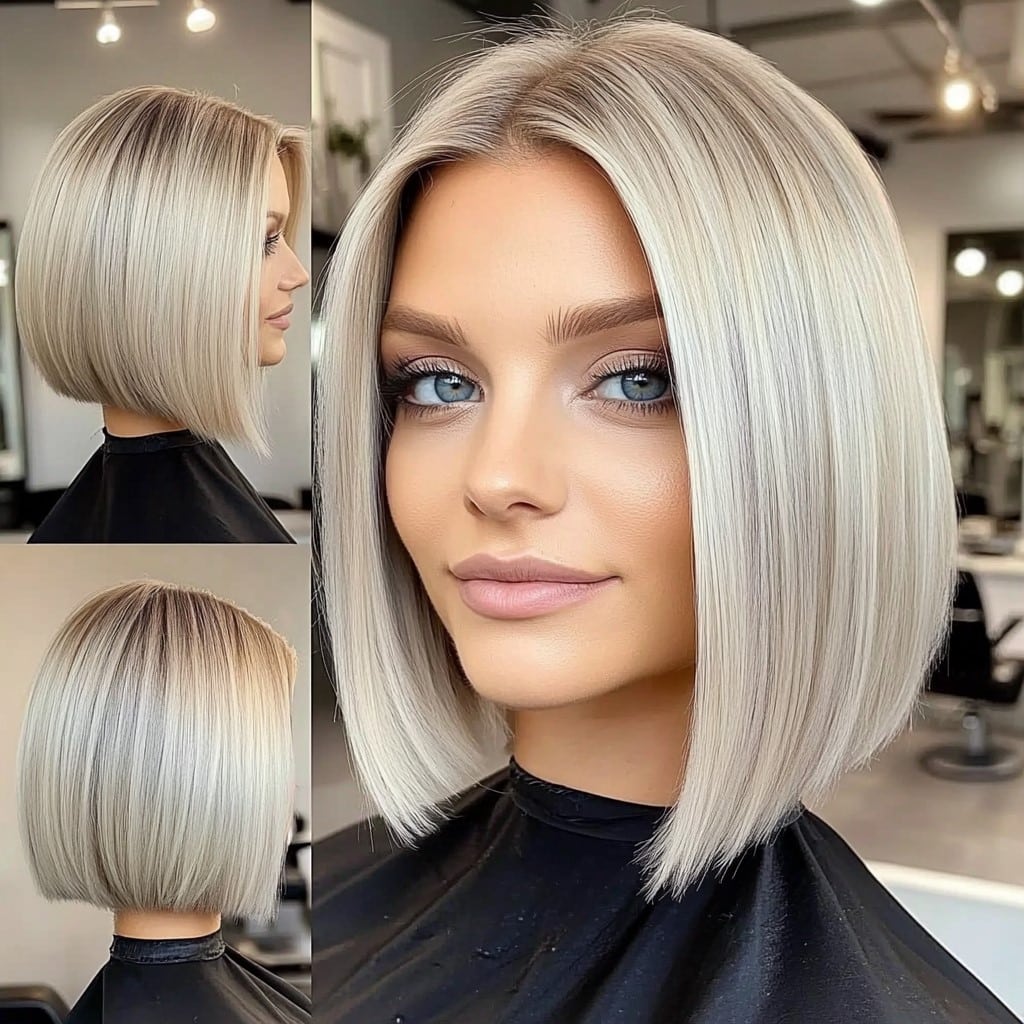
Turn around and this one gets even better. The three views show an icy silver blonde with a soft shadowed root, cut so the front sits at the chin and the back is slightly shorter and rounded at the nape. From the side you can see the gentle forward angle; from behind, the ends curve under in a neat bowl shape. A center part keeps the front perfectly balanced, so the line looks the same whichever side someone sees first.
- Best for: Straight, fine to medium hair; anyone who wants a short bob that still covers the neck.
- Ask your stylist for: A chin-length A-line bob with light graduation at the nape, the front slightly longer, and a center part.
- How to style it: Blow-dry with a medium round brush, rolling the ends under at the back and straight down at the front.
- Upkeep: Trim every 5 to 6 weeks; silver toner or purple shampoo weekly to keep the shade cool.
4. The rooted blonde selfie lob

If you’re growing out a darker base, this is a smart way to make it look intentional. Ash-brown roots fan out from the center part and melt into bright buttery blonde through the lengths. The cut stops at the collarbone and is kept straight, with the ends left slightly airy rather than pressed flat, so the hair moves when you turn your head. The deeper root also makes the part itself look fuller, which helps if your hair is fine at the crown.
- Best for: Fine to medium straight hair; anyone who wants long gaps between color appointments.
- Ask your stylist for: A collarbone-length bob with a center part, a blended root shadow and very light texturizing on the ends.
- How to style it: Rough-dry, then smooth the lengths with a flat iron and leave the last inch unpressed.
- Upkeep: Trim every 8 weeks; highlights every 12 to 14 weeks thanks to the rooted base.
Rooted and face-framing middle part bobs
These three soften the symmetry with longer front pieces and blended roots, so the part looks relaxed rather than ruler-straight.
5. The buttercream long bob

Long bob, low effort, lots of light: that is the appeal here. A dark blonde root blends into pale buttercream ends, and the center part lets both sides fall past the jaw toward the collarbone. The lengths are smooth with a soft bend rather than poker straight, and the ends curve gently toward the neck. Keeping the front pieces a little longer than the back means the hair frames the face as it falls, even when you push it behind your shoulders.
- Best for: Medium to thick straight hair; anyone wanting a bob that can still go in a low ponytail.
- Ask your stylist for: A collarbone-length bob, slightly longer at the front, with a center part and a soft root melt.
- How to style it: Blow-dry with a large round brush, bending the ends under, then finish with a light smoothing serum.
- Upkeep: Trim every 8 weeks; root melt and toner every 10 to 12 weeks.
6. The money piece flick

Bright pieces at the front, a deeper bronde everywhere else: the contrast is what makes this cut feel fresh. The part sits at the center and the blonde sections on either side frame the cheeks and jaw, while the lengths stop between the chin and shoulders. Look at the ends: they bend outward and separate into soft points, giving the bob a relaxed, slightly undone finish. It is a good choice if you like a center part but don’t want it to look severe.
- Best for: Fine to medium hair with a slight natural bend; anyone who prefers an undone finish.
- Ask your stylist for: A chin-to-shoulder bob with point-cut ends, a center part and face-framing money pieces.
- How to style it: Blow-dry straight, then flip the ends outward with a flat iron and twist a little texture spray through them.
- Upkeep: Trim every 6 to 8 weeks; refresh the face-framing highlights every 8 to 10 weeks.
7. The honey curtain bob

Picture a curtain bang that grew out and kept going, and you have this bob. Honey blonde lengths with a slightly deeper root are parted down the middle, and the front layers start around the cheekbones before blending into the rest of the cut just above the shoulders. The ends are soft and piecey, not blunt, so the shape looks lived in from the first day. Oversized sunglasses push the front back easily, and the layers fall straight back into place.
- Best for: Fine to medium straight or slightly wavy hair; anyone growing out bangs.
- Ask your stylist for: A bob just above the shoulders with a center part, long curtain-style front layers and softly texturized ends.
- How to style it: Blow-dry the front pieces away from the face with a round brush, then smooth the back with a flat iron.
- Upkeep: Trim every 6 to 8 weeks; gloss or tone every 8 weeks to keep the honey warm.
Brunette, beige and black middle part bobs
Deeper shades turn a center part into a strong, glossy line. Shine matters most here, so a smoothing routine pays off; our brunette bob haircuts show more dark options.
8. The espresso everyday bob

Some cuts look good in a casual sweatshirt and a no-makeup day, and this is one of them. Deep espresso brown is parted straight down the middle and falls sleek to just below the chin, with a hint of lighter brown catching the light through the lengths. The ends curve slightly toward the neck, which keeps the shape compact and stops it from flaring out. Because the perimeter is level, it looks neat even after you’ve slept on it.
- Best for: Straight, medium to thick hair; anyone who wants a short bob that needs little daily styling.
- Ask your stylist for: A chin-length blunt bob with a center part, light internal thinning and ends cut to fall slightly under.
- How to style it: Air-dry with a smoothing cream, then touch up the ends with a flat iron if they kink.
- Upkeep: Trim every 6 weeks to keep the ends falling under.
9. The mushroom beige glass lob
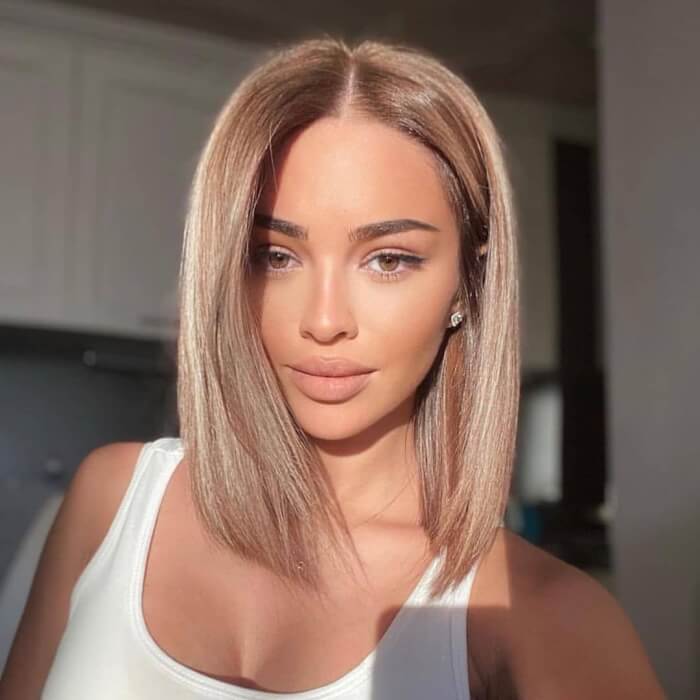
Long, flat and very straight, this lob looks almost liquid. A cool mushroom-beige base is lifted with fine honey strands, and the center part sends both sides straight down past the shoulders to the collarbone. There are no visible layers, so the ends land in one blunt line that falls forward over the chest. The lack of volume is deliberate: smoothing the hair close to the head makes the length look longer and the part look sharper. Simple, and that’s the point.
- Best for: Straight, fine to medium hair; anyone who likes sleek hair and wants to keep some length.
- Ask your stylist for: A collarbone-length one-length bob with a center part and a blunt perimeter, no face-framing layers.
- How to style it: Flat-iron in small sections from root to tip and finish with a drop of lightweight oil.
- Upkeep: Trim every 8 weeks; gloss every 8 weeks to keep the beige from turning warm.
10. The jet-black curtain-framed bob

If your hair is dark and thick, this is how to make a center part look soft instead of heavy. Glossy jet black is cut to the shoulders, and the front is layered into curtain-style pieces that start at the cheekbones and sweep away from the face. The rest of the lengths are smooth and turn under slightly at the ends. Those face-framing layers are the trick: they break up the solid block of color, so the cut has shape around the face and weight at the hem.
- Best for: Thick, straight or slightly wavy dark hair; anyone who wants softness around the face.
- Ask your stylist for: A shoulder-length bob with a center part, curtain-style face-framing layers from the cheekbones and the ends beveled under.
- How to style it: Blow-dry the front pieces back and away with a round brush, then smooth the lengths and roll the ends under.
- Upkeep: Trim every 6 to 8 weeks; refresh the face-framing layers every 6 weeks.
How to style a middle part bob at home
For a sleek, glassy finish
- Comb a clean center part on wet hair with a fine-tooth comb, lining it up with the bridge of your nose.
- Apply heat protectant and a light smoothing cream through the lengths.
- Blow-dry each side down and away from the part, pointing the nozzle toward the ends.
- Flat-iron in small sections and curve only the last half-inch under.
- Finish with a shine spray from a distance so the part does not separate.
For a soft, lived-in finish
- Rough-dry hair until it is about 80 percent dry, pushing the roots side to side to stop the part from lying flat.
- Wrap the mid-lengths around a 1.25-inch curling iron, leaving the ends out.
- Shake the waves out with your fingers once they cool.
- Twist a little texture spray through the front pieces so they frame the face.
Keeping a middle part bob level
A center part makes any unevenness obvious, so trims every five to eight weeks are worth booking ahead. If one side always looks longer, check that you are parting in the same place each day; a part that drifts even a little shifts the length. Hair that has been parted on one side for years may resist at first, so blow-dry the roots in the opposite direction for a week or two to retrain them. To grow a middle part bob into a long bob, keep the perimeter blunt and simply trim less often, as with the cuts in our lob haircuts.
What to tell your stylist
- That you will wear the bob with a center part, so they cut and check it that way.
- Where you want the length: jaw, chin, shoulders or collarbone.
- Whether you want a level blunt line, a slight A-line or face-framing layers.
- Any cowlick or strong growth pattern at the front hairline.
- How you style it most days: air-dried, blow-dried or flat-ironed.
Frequently asked questions
Does a middle part bob work on fine hair?
Yes. A blunt perimeter at jaw or chin length keeps the ends looking thick on both sides of the part. Avoid heavy layering at the front, which can make fine hair look sparse.
How do I stop my middle part from flipping to one side?
Part your hair while it is wet and blow-dry the roots in both directions before drying the lengths. If you have a cowlick, longer front pieces add weight and help the part lie flat.
Is a middle part bob different from a side-parted bob?
The cut can be similar, but a stylist should check the length with the part where you will wear it. A center part shows any unevenness straight away, while a side part hides it in the sweep.
How often should a middle part bob be trimmed?
Short, blunt versions look best trimmed every five to six weeks. Collarbone-length cuts can usually go eight weeks.
For more sleek bob ideas, see our sleek one-length bob haircuts, shoulder-length bob hairstyles, jaw-length blunt bobs and short blonde bob ideas.