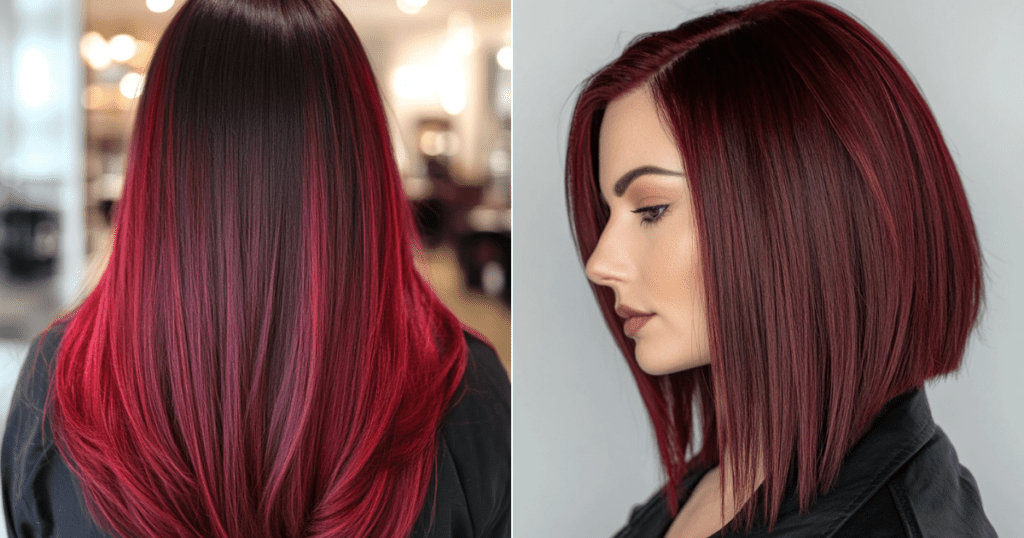
Red is the hardest color to keep looking fresh at the root, and that is exactly why ombre suits it so well. Leave the top dark, let the red build down the lengths, and the regrowth simply becomes part of the fade. You get all the heat of a vivid shade on the ends, where it moves and catches light, with a grown-out phase that looks intentional rather than overdue.
These 31 red ombres cover the whole spectrum. There are glossy black-to-cherry bobs, long waves that burn from wine into orange and gold, softer copper melts on brown hair, and berry and pink-tipped fades for anyone who likes red with a cooler edge. For each one you’ll find who it suits, what to ask your colorist for, how to style it and how often it needs a refresh. If you want something more blended than a fade, our red balayage ideas show hand-painted placement instead.
How to choose a red ombre
Start with your natural root color, because a red ombre keeps it. Black and dark brown roots make bright red ends look electric; medium brown roots suit copper and auburn fades. Then decide where the transition sits: a high fade starting at the cheekbones gives more red, a low fade from the collarbone keeps it subtle.
| Hair type | Red ombres that work best | What to avoid |
|---|---|---|
| Fine or thin | A soft burgundy or copper fade starting at the jaw, with gentle waves for fullness | Heavy bleaching of the ends, which can leave them thin and see-through |
| Thick | High-contrast black-to-cherry or fire ombre on long waves, where the color has room to graduate | A short fade zone, which leaves a hard line across thick lengths |
| Straight | Sharp black-to-red on a blunt bob or lob, where the gradient shows like a dip-dye | Uneven blending, which shows clearly on straight hair |
| Wavy or curly | Fire, copper or berry ombre that changes shade on every bend | Very pale ends, which can dry out curl pattern |
| Gray or salon-lightened | Copper, strawberry or pink-tipped fades that sit over lighter bases | Deep wine ends on very porous hair, which fade unevenly |
Bright or deep: cherry, scarlet and orange ends usually need pre-lightening and fade fastest, while burgundy and auburn can often go over lightly lifted brown. Length: a bob shows a clean, graphic fade; long hair gives room for three-tone fire blends. For classic two-tone ideas in other colors, see our ombre hair color ideas.
Black-to-red and dark cherry fades
The classic red ombre: dark roots that slide into cherry, crimson or wine. On bobs it looks graphic and sharp; on long waves the red seems to glow from underneath. For more high-contrast pairings, our red and black hair ideas go even bolder.
1. The dip-dyed cherry bob
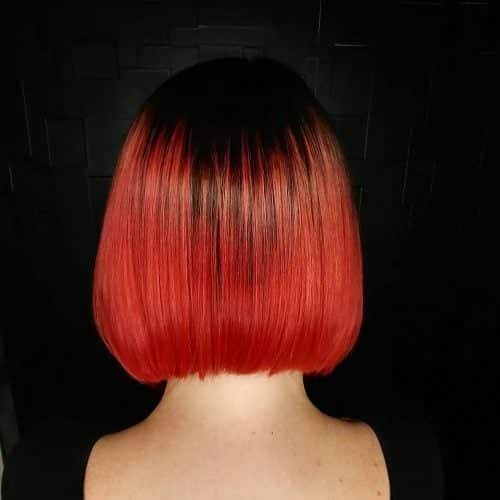
Turn around, and this is the view everyone gets: a blunt chin-length bob that drops from inky black at the crown into bright cherry red. The straight, one-length perimeter is what makes the gradient look so clean, almost like the ends were dipped in paint. Against a dark background the red seems to glow. Because the cut has no layers, every strand shows the full fade from root to tip. Graphic, simple and very hard to ignore.
- Best for: Straight, medium to thick hair; anyone who wants a bold, structured look.
- Ask your stylist for: A blunt chin-length bob with no layering; black or darkest brown roots blended into pre-lightened cherry red ends.
- How to style it: Blow-dry straight with a paddle brush, then run a flat iron over the lengths for a glassy finish.
- Upkeep: Trim every 6 to 8 weeks; refresh the red every 4 to 6 weeks with a red color-depositing conditioner between visits.
2. The scarlet bob with micro bangs
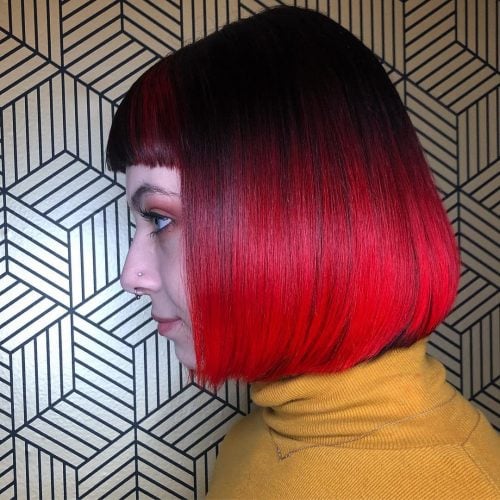
If you like your hair with a bit of punk attitude, look here. Very short micro bangs sit high on the forehead, and the bob is cut blunt just below the jaw. The color starts black at the root and the bangs, then shifts into a pure scarlet through the lower half. The profile view shows how tidy the line is from the fringe to the nape. Paired with a mustard roll-neck, the red reads even brighter.
- Best for: Straight hair; anyone comfortable with a strong fringe and high contrast.
- Ask your stylist for: A blunt bob just below the jaw with micro bangs; black roots fading into vivid scarlet on pre-lightened ends.
- How to style it: Blow-dry the bangs flat first with a small brush, then smooth the bob with a flat iron, bending the ends slightly under.
- Upkeep: Bang trims every 3 weeks; full trim every 6 weeks; red refresh every 4 weeks.
3. The long-front crimson lob
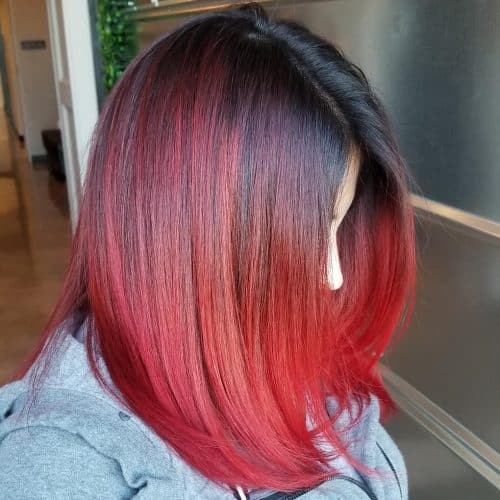
Asymmetry gives a fade more room to show off. This lob is longer at the front, falling past the collarbone, and the black roots melt into crimson about halfway down. A deep side part flips extra hair to one side, so the brightest red frames the face. Smooth, straight styling shows each layer of the gradient, from inky to scarlet. It’s an easy way to try vivid red without committing your whole head.
- Best for: Straight to slightly wavy hair of medium density.
- Ask your stylist for: An asymmetric lob with longer front sections and a deep side part; dark roots melted into crimson from mid-length.
- How to style it: Blow-dry smooth with a round brush, flipping the front pieces forward.
- Upkeep: Trim every 6 to 8 weeks; gloss the red every 5 weeks.
4. The black-to-wine straight lob
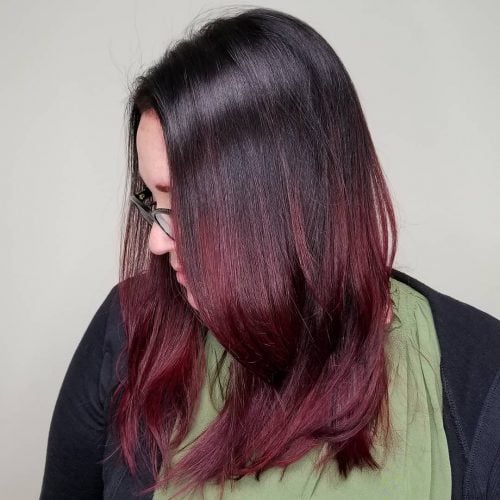
Some reds whisper. This one starts black and glossy at the top and slides into a deep wine shade only through the lower third, so it reads as dark hair until the light hits the ends. The cut is a long, straight lob with soft face-framing pieces. It works well with glasses, as here, because the color stays low-key around the face. A smart choice for offices that frown on anything brighter.
- Best for: Dark straight hair; anyone who wants a subtle first step into red.
- Ask your stylist for: A long lob with light face-framing layers; a low ombre from natural black into deep wine on the ends.
- How to style it: Smooth with a flat iron and finish with a drop of shine serum on the ends.
- Upkeep: Trim every 8 weeks; refresh the wine tone every 6 to 8 weeks.
5. The feathered black-cherry layers
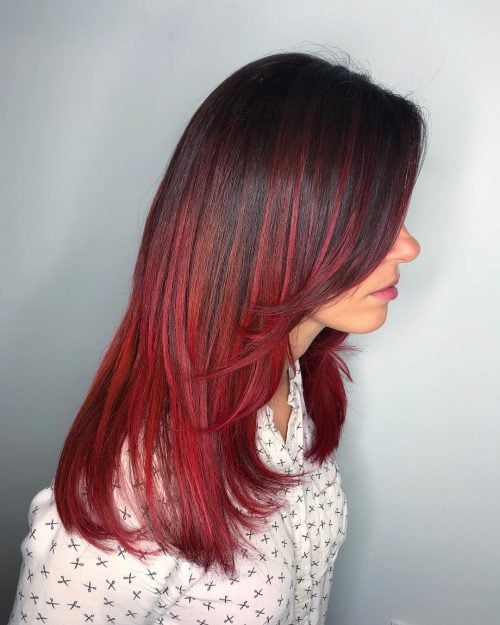
Layers are the secret here. Long, feathered pieces cut around the face mean the cherry red ends sit at different heights, so the fade looks soft rather than striped. The top stays a deep black, and the red grows stronger toward the shoulder-length tips. Seen in profile, a longer fringe piece sweeps across the cheek in red. The overall effect is movement, even on straight hair.
- Best for: Straight, medium-density hair; anyone who wants a softer fade than a blunt cut gives.
- Ask your stylist for: Shoulder-length hair with long, feathered face-framing layers; dark roots blended into cherry red, strongest at the ends.
- How to style it: Blow-dry with a round brush, turning the ends away from your face.
- Upkeep: Trim every 8 weeks; red refresh every 5 to 6 weeks.
6. Shadow roots with red waves
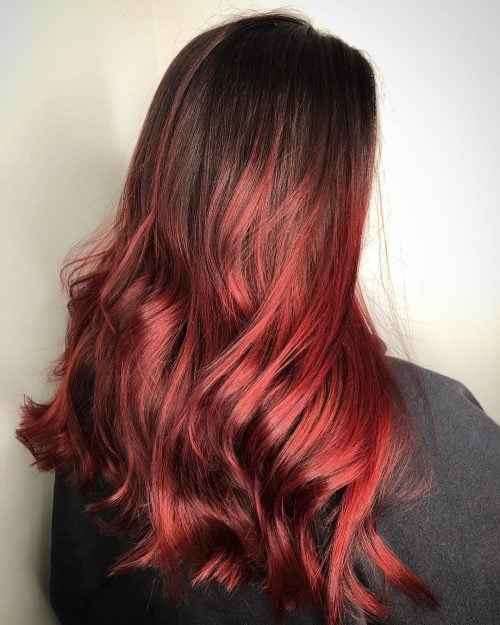
Think of this as red ombre for people who hate the look of regrowth. A dark brown shadow root is left untouched at the top, then bright red takes over from the ears down. Loose, polished waves break the color into ribbons, so the lighter and darker reds alternate on each bend. The longer the root, the longer you can go between appointments, which is the real point of the design.
- Best for: Medium to thick hair with some natural wave.
- Ask your stylist for: A deep shadow root, around 3 inches, with bright red from the ears down and soft long layers.
- How to style it: Curl in large sections with a 1.25-inch iron and brush through gently for loose waves.
- Upkeep: Trim every 8 to 10 weeks; refresh the red every 6 weeks.
7. The half-up scarlet blaze
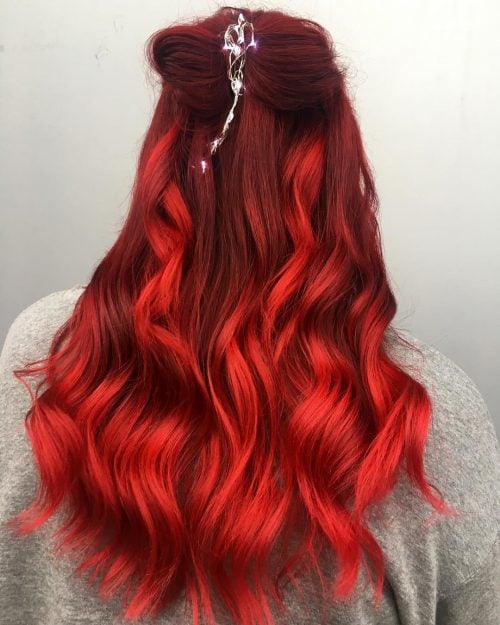
Planning something special? A half-up style shows off a red ombre better than any other, because the darker top is gathered away and the brightest color spills down the back. Here the crown is a deep red, twisted up and fixed with a jeweled clip, while the long waves below turn a vivid scarlet. The contrast between the smooth top and the full waves makes the color look layered.
- Best for: Long, thick hair; events and weddings.
- Ask your stylist for: Deep red roots graduating to vivid scarlet ends with long layers to support waves.
- How to style it: Curl the lengths, then twist the top section back and secure it with a decorative clip.
- Upkeep: Refresh the red every 4 to 6 weeks; trim every 10 weeks.
8. Crimson ends with a crystal clip
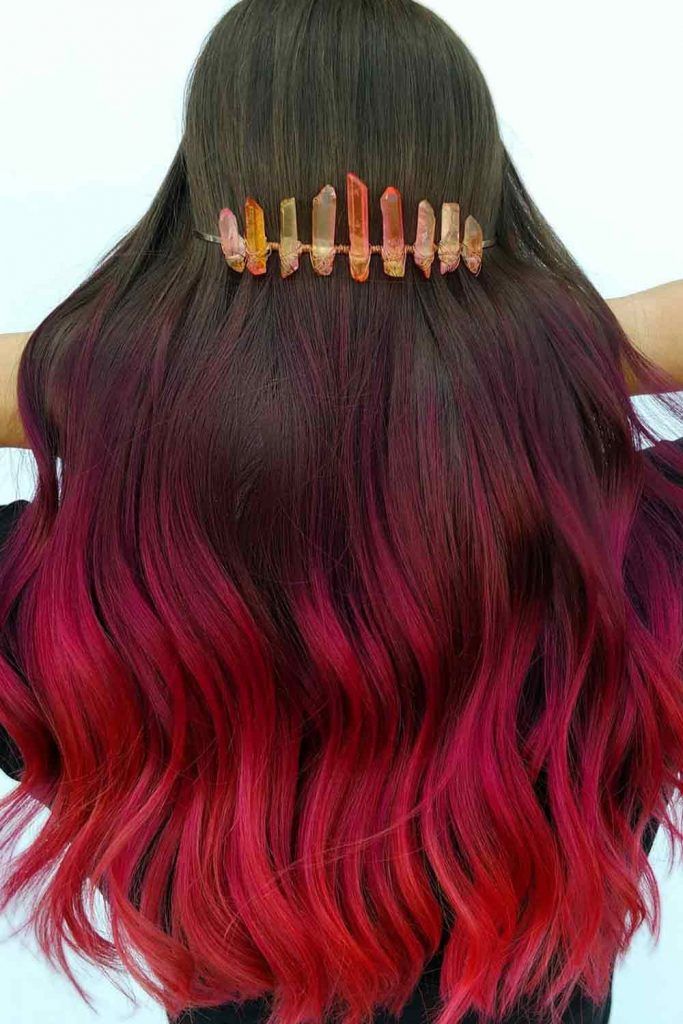
A low ombre lets you keep almost all of your natural brunette and still wear real red. The dark brown sits through the top two-thirds of this long hair, then shifts into a deep crimson at the ends. A row of orange crystal points clipped across the back adds a playful touch that picks up the red. Soft, slightly bent ends keep the shade looking rich.
- Best for: Long dark hair; anyone who wants vivid color only at the tips.
- Ask your stylist for: A low ombre starting below the shoulder blades, from natural dark brown into crimson on lightened ends.
- How to style it: Leave it straight or add a soft bend with a large barrel iron; add a hair clip for interest.
- Upkeep: Trim every 10 to 12 weeks; refresh the ends every 6 weeks.
9. The cherry fade with full bangs
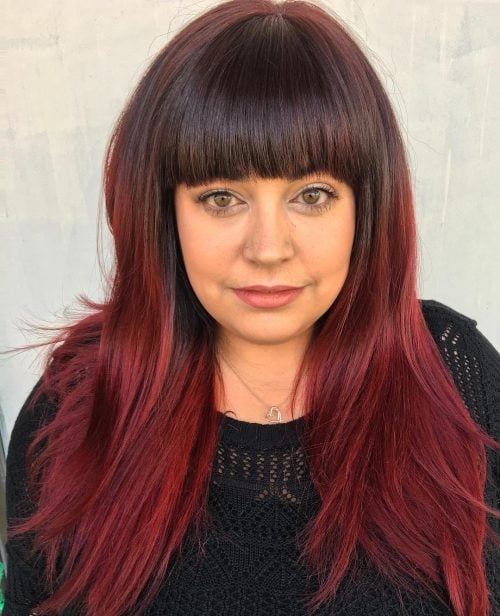
Full bangs and a red fade make a strong pairing, as this front view shows. The thick, straight fringe sits just above the brows in a darker brown-red, and the long, layered lengths turn cherry red from the chin down. The bangs frame the face while the layers keep the length from feeling heavy. Because the red is brightest at the bottom, the overall look stays warm and approachable.
- Best for: Straight, medium to thick hair; anyone who already wears bangs.
- Ask your stylist for: Long layers with full brow-length bangs; darker roots and bangs, cherry red from the chin down.
- How to style it: Blow-dry the bangs first, then smooth the lengths with a paddle brush.
- Upkeep: Bang trims every 3 to 4 weeks; color refresh every 6 weeks.
10. The dark wine wave
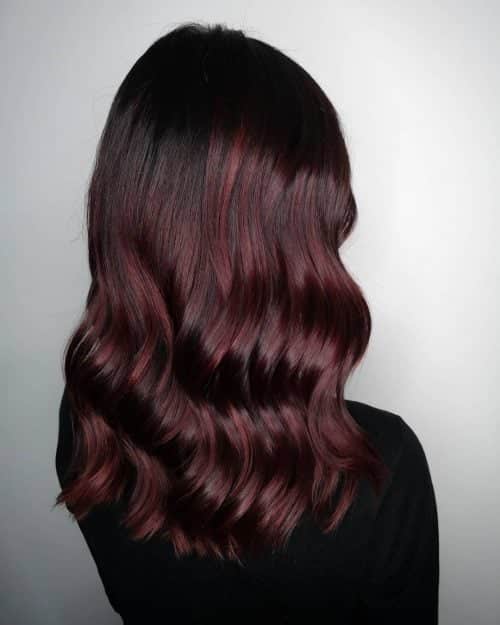
Wine red is easy to live with, and this fade proves it. The roots are almost black, then the color warms into a deep merlot through soft, defined waves that end just past the shoulders. Indoors it reads as dark brunette; outside, the red comes alive along each wave. The shift is so gradual that there’s no visible line, which is the hallmark of a well-blended ombre.
- Best for: Dark brown or black hair of any density.
- Ask your stylist for: A gradual ombre from natural dark roots into deep wine red, blended with no visible line.
- How to style it: Use a 1-inch iron for defined waves and set them with a light hairspray.
- Upkeep: Trim every 8 weeks; gloss every 6 to 8 weeks.