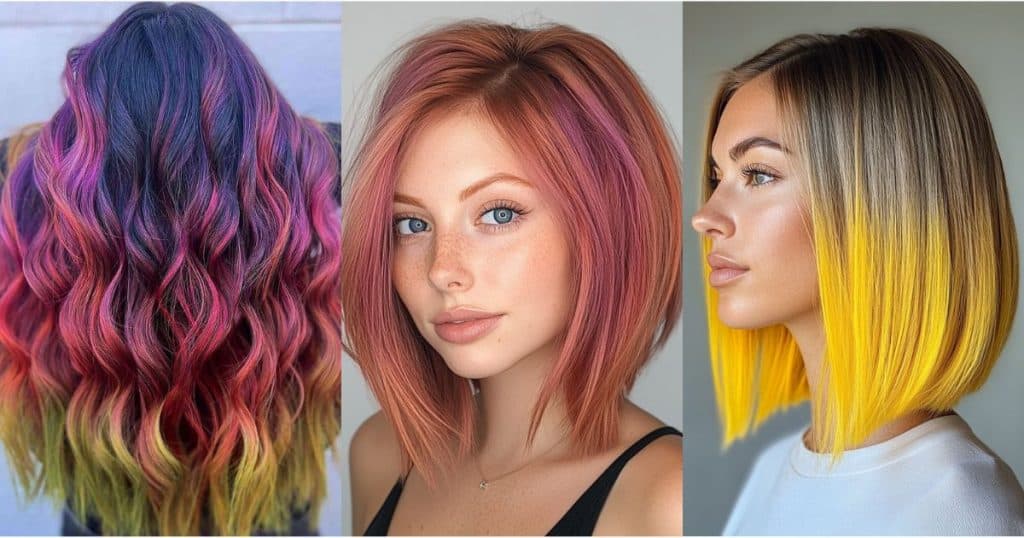
Two colors are always more interesting than one, as long as you decide how they meet. Blend them and your hair moves from magenta to orange to gold like a sunset. Separate them and you get a crisp split right down the part. In between sit face-framing panels, dipped ends and dark roots melting into a jewel tone. The placement changes the look as much as the shades do, and it decides how much bleach you need.
The 26 ideas below are grouped by technique: blended sunset fades, split dye and color blocking, panels and dipped ends, and dark roots with a single bright shade. Each one notes who it suits, what to ask your colorist for, how to style it and how quickly it fades. For a broader mix of natural and bright shades, browse our hair color ideas.
How to choose a two-tone hair color
Start with how much of your hair needs lightening. Bright shades only show clearly on hair lifted to a pale yellow, so a full sunset fade on dark hair means bleaching most of the head, while a single face-framing panel or dipped ends needs far less. Then decide whether you want the colors blended or separated: blends grow out softly, sharp splits make a stronger statement but show regrowth sooner.
| Natural hair | Two-tone placement that works best | What to avoid |
|---|---|---|
| Black or very dark brown | Dark root with a jewel tone, face-framing panels, dipped ends | Pastel shades all over, which need the hair lifted almost to white |
| Medium brown | Split dye with one bright side, red or copper melts, teal or magenta ends | Very pale yellow fades that show orange as they wash out |
| Blonde | Sunset fades, pastel splits, peach and pink melts | Dark navy or black sections, which are hard to remove later |
| Fine or damaged | Panels or ends only, so the root area stays untouched | Full-head bleach and multiple bright shades at once |
| Thick or coarse | Wide color blocks and long fades that show on a lot of hair | Very fine stripes, which get lost in dense hair |
Bright, semi-permanent shades fade fastest, with pinks and oranges usually lasting four to six weeks and blues and teals a little longer. Plan on a color-depositing conditioner and cool-water rinses, and expect to refresh the brightest sections every month or two. If you only want a flash of color that hides when your hair is down, our underdye hair color ideas keep the bright shade underneath.
Sunset and fire fades
These looks blend warm shades into one another, usually magenta or red at the root moving to orange and yellow at the ends, like a sky at dusk. If the orange end of the spectrum is your favorite, see our orange hair color shades.
1. The fire-flip side-part bob
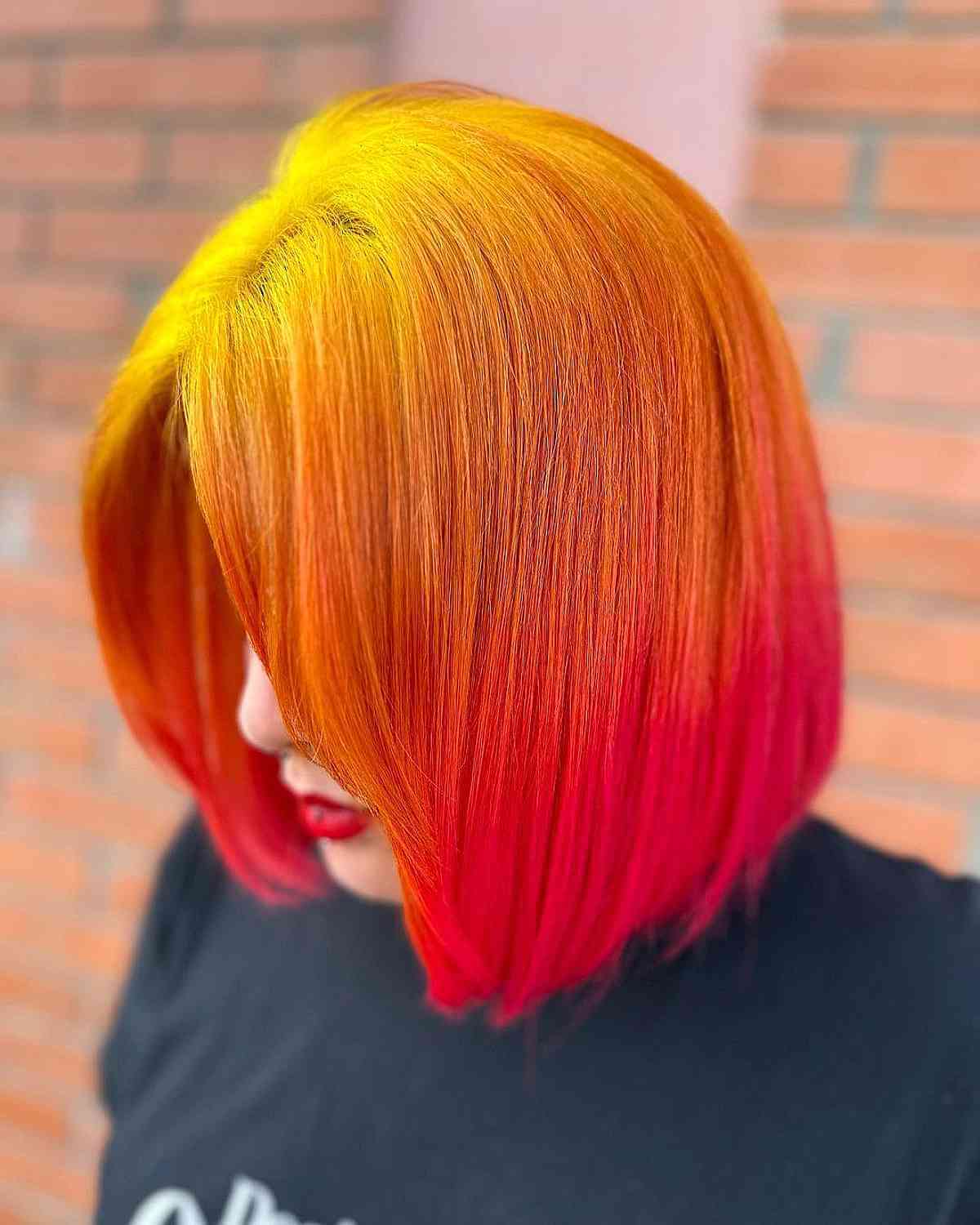
Most fades go dark to light. This one flips the rule. A sleek, chin-length bob starts golden yellow at the root and moves through orange to bright cherry red at the ends, so the deepest shade lands at the jaw. Worn straight with a deep side part, one long section falls over the eye and shows the whole gradient in a single sweep. Bold, graphic and impossible to miss.
- Best for: Straight hair that has been lightened to pale blonde; anyone who wants a graphic, polished bright color.
- Ask your stylist for: A chin-length bob with a deep side part, colored in a vertical melt from yellow at the root through orange to red ends, with no visible lines between shades.
- How to style it: Blow-dry straight with a paddle brush and finish with a shine spray so the color looks glossy.
- Upkeep: Color refresh every 4 to 6 weeks; root lightening every 6 to 8 weeks.
2. The magenta-edged flame waves
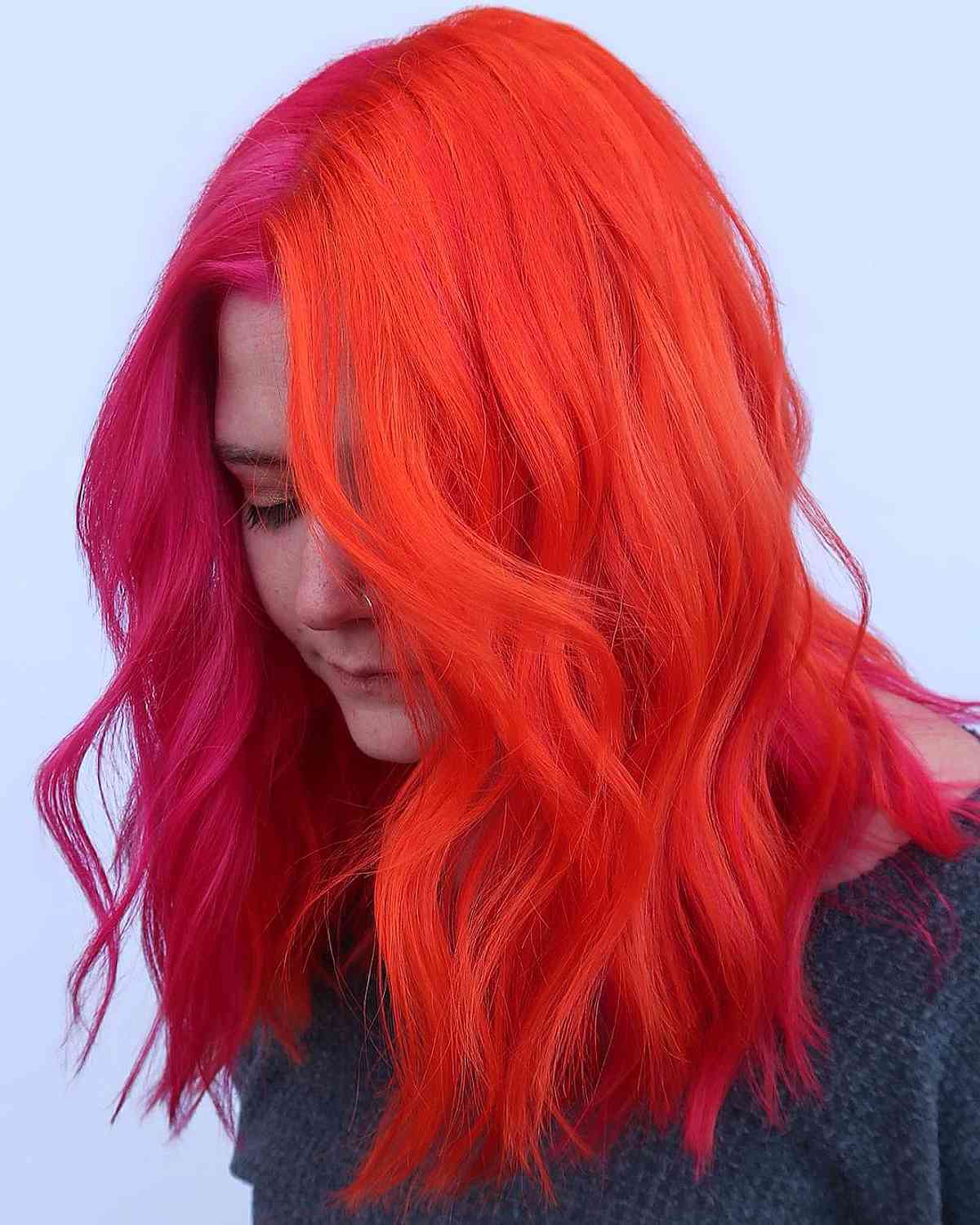
Two neighbors on the color wheel will always blend nicely, and this is the proof. Magenta runs along the part and down one side, while the rest of the shoulder-length hair glows a bright flame orange-red. Soft waves mix the shades where they meet, so there is no hard edge, just heat. If you want vivid color that still looks cohesive, pair shades that sit side by side like these.
- Best for: Blonde or lightened hair; those who want a bold warm look with a twist.
- Ask your stylist for: Bright orange-red through most of the hair, with a magenta section along the part and one side, blended where they meet.
- How to style it: Curl loosely with a 1.25-inch wand and brush through for soft, open waves.
- Upkeep: Color-depositing conditioner weekly; refresh every 4 to 6 weeks.
3. The long magenta-to-gold sunset
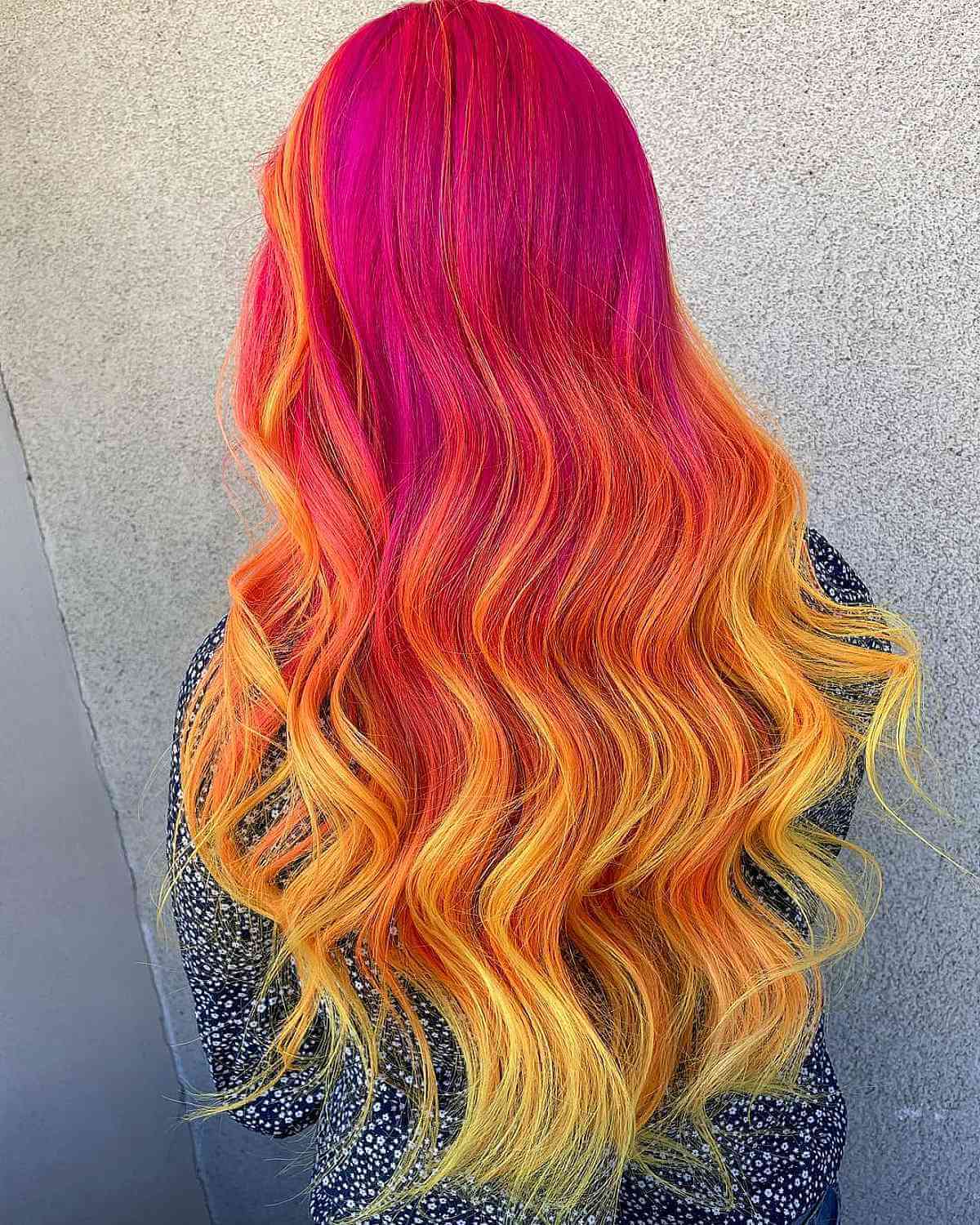
Think of a sky at dusk and you’re halfway there. Hot magenta covers the root and crown, then gives way to coral and orange through the mid-lengths and golden yellow at the ends. The long, uniform waves let each band show clearly from behind. That yellow only works on hair lifted almost to white, so this one suits naturally light or previously lightened hair best. Pure warmth, top to bottom.
- Best for: Long hair in good condition that can be lightened to a pale level.
- Ask your stylist for: A three-shade sunset melt: magenta at the root, orange through the middle and yellow ends, with each shade blended into the next.
- How to style it: Set the hair in large curls, let them cool and brush them out into loose waves.
- Upkeep: Refresh every 4 to 6 weeks; wash in cool water to slow fading.
4. The woven wine-root blaze
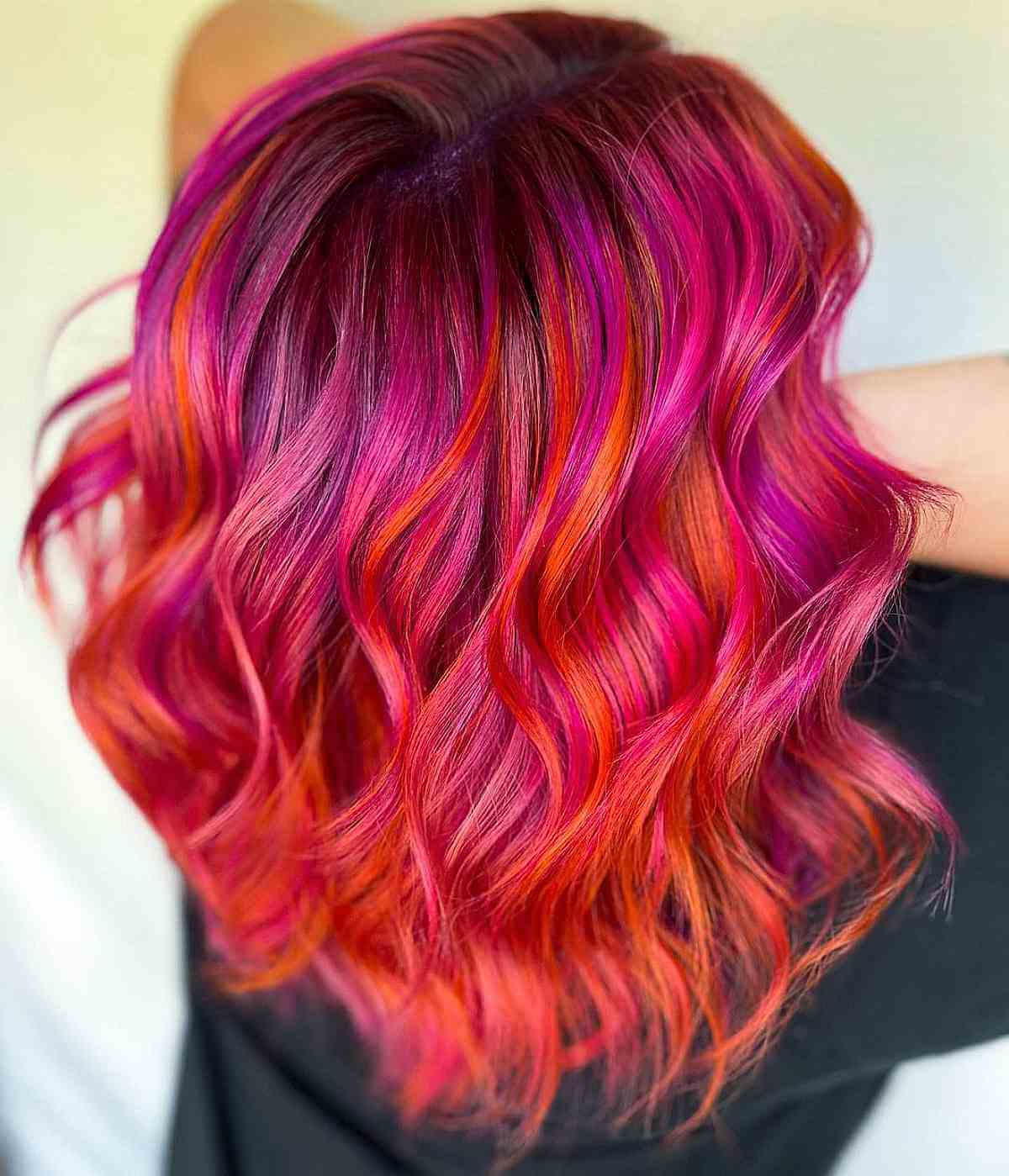
Prefer a tangle of color to neat stripes? Look here. A deep wine root runs into hot pink, orange and red ribbons that are woven through the hair rather than stacked in bands. The tousled, shoulder-length waves mix them into a glowing, fire-like effect. Keeping the root dark is the clever bit: regrowth blends in for weeks longer than it would on a fully bright head of color.
- Best for: Medium to dark hair; those who want bright color with a softer grow-out.
- Ask your stylist for: A deep wine shadow root with woven pink, orange and red ribbons through the lengths.
- How to style it: Spray a texturizing spray through dry hair and twist small sections with a wand for messy waves.
- Upkeep: Gloss the brights every 4 to 6 weeks; root color every 8 weeks.
5. The berry-to-apricot layers
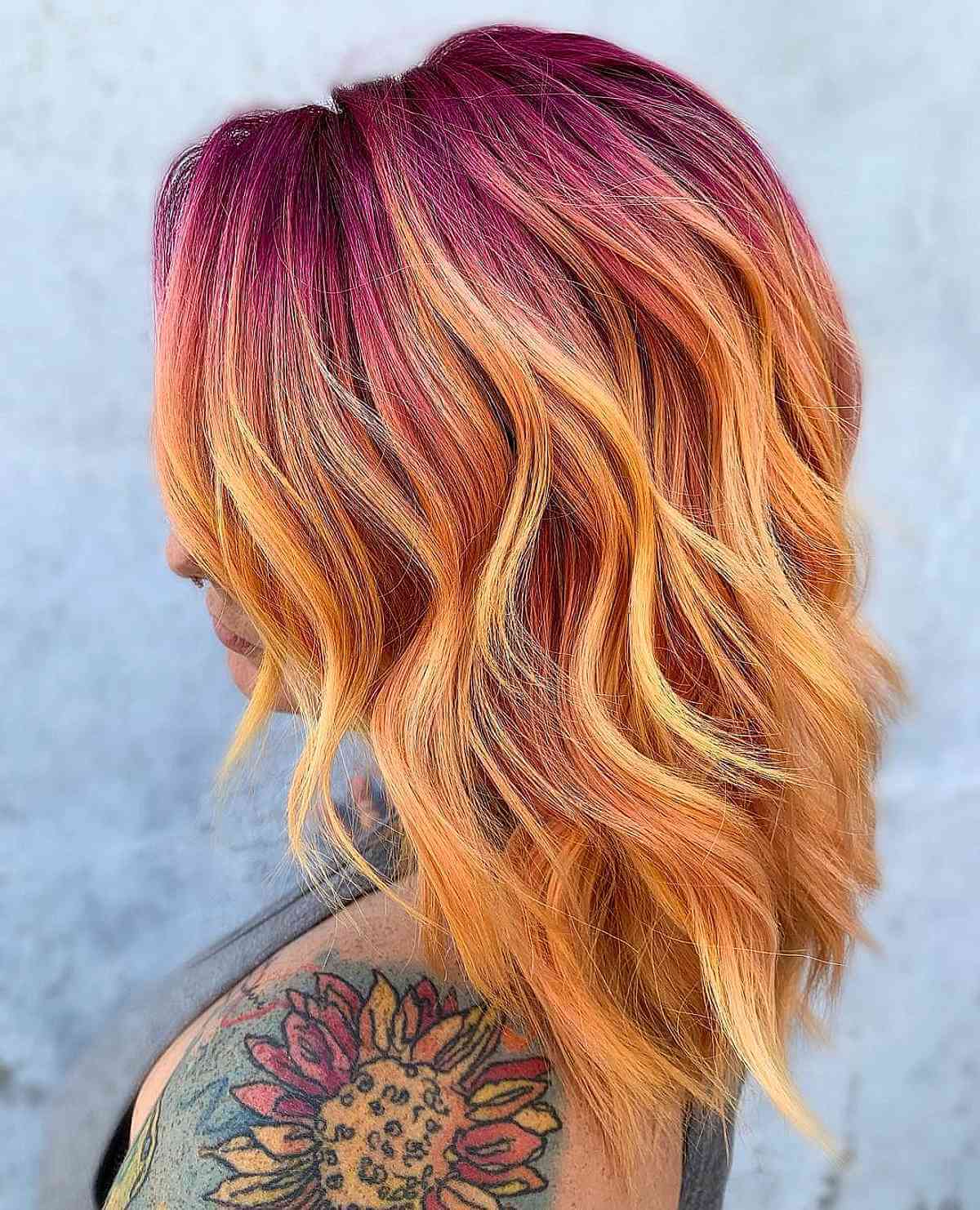
Not quite neon, not quite natural, and that’s the charm. Seen from the side, this layered, shoulder-length cut has a berry-magenta root that melts into apricot orange and then soft golden blonde at the ends. The layers flip at different points, so the colors tumble over one another as the hair moves. Softer shades like these also fade more gracefully than pure brights, which buys you time between refreshes.
- Best for: Wavy hair of medium density; those who want a sunset look that is not too intense.
- Ask your stylist for: A layered shoulder-length cut with a berry root and a soft melt into apricot and gold through the lengths.
- How to style it: Diffuse with a light curl cream, then twist a few front pieces for definition.
- Upkeep: Refresh every 6 weeks; trim every 8 to 10 weeks.
6. The striped sunset sheet
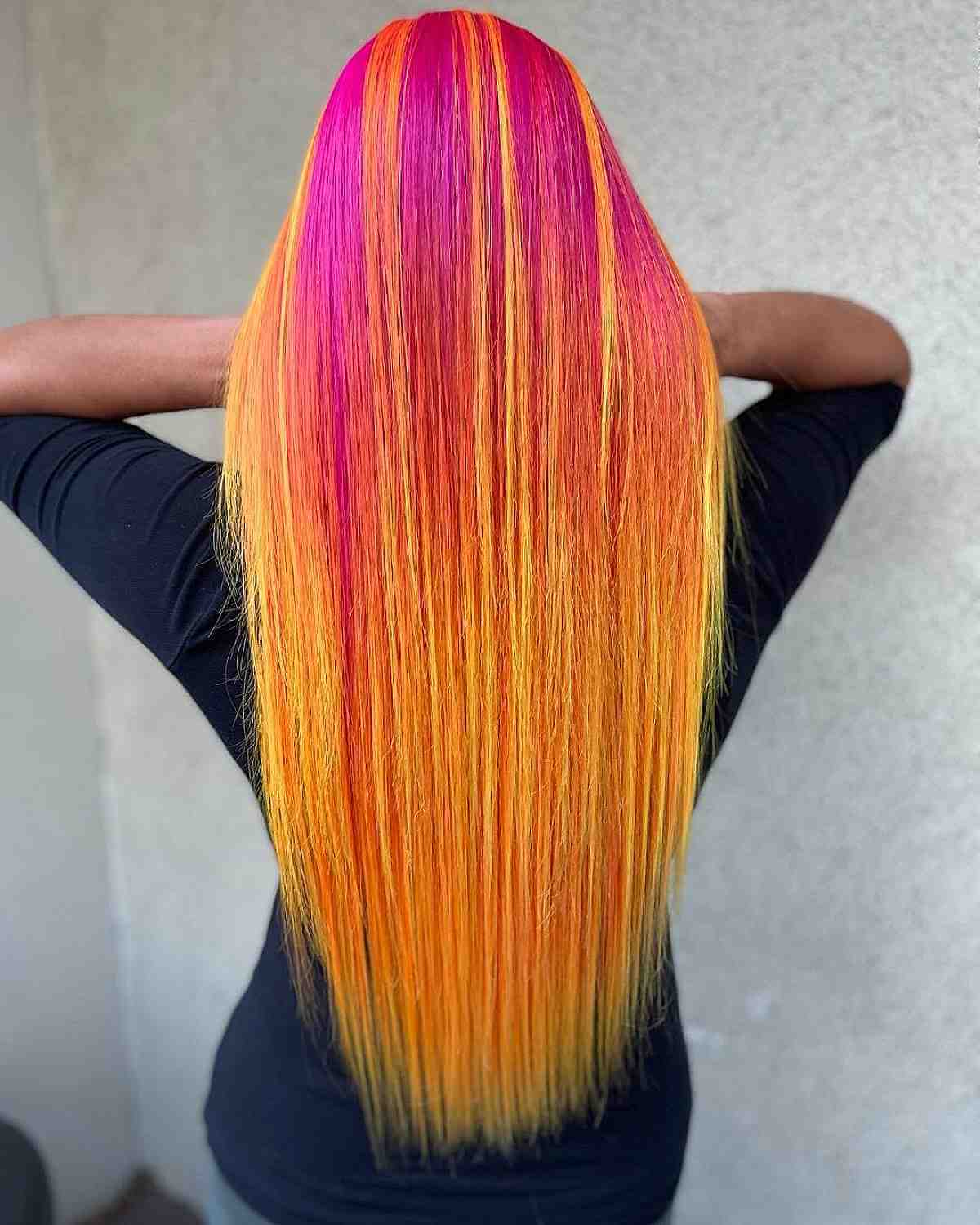
Poker-straight hair turns color into fabric. This very long cut is magenta at the root, orange through the lengths and nearly yellow at the ends, and fine yellow streaks run vertically through the magenta to tie the top and bottom together. Worn completely straight, every strand shows like a woven stripe. You will need patience with a flat iron, but the payoff is graphic and very precise.
- Best for: Long, straight hair; anyone willing to keep up with frequent color refreshes.
- Ask your stylist for: A vertical melt from magenta to orange to yellow, with fine yellow babylights running through the magenta root area.
- How to style it: Flat-iron straight in small sections and finish with a lightweight shine serum.
- Upkeep: Refresh every 4 weeks; dusting trims every 8 weeks to keep the ends healthy.
7. The indigo-to-lime fade
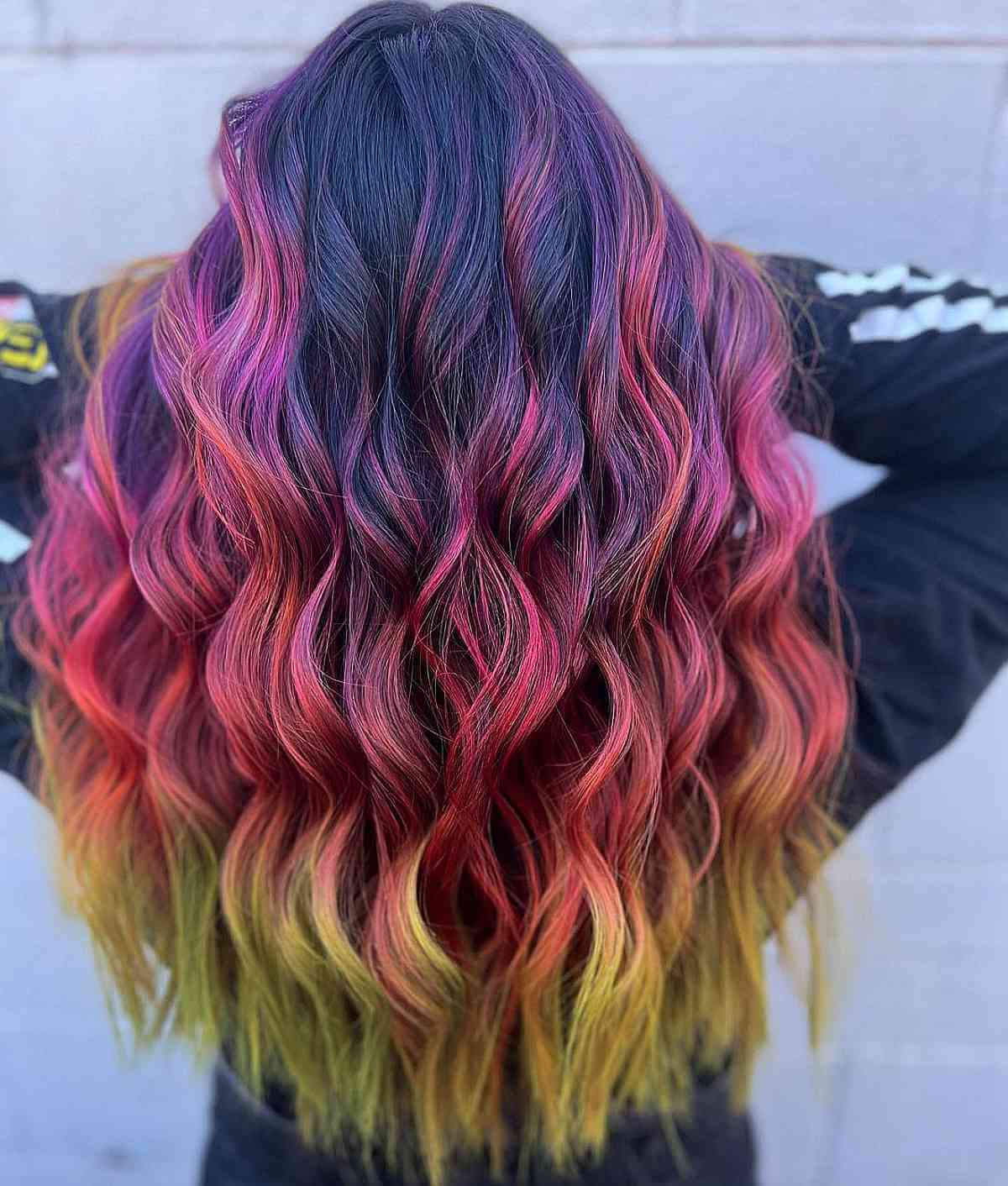
A sunset with a cool start. From the back, an indigo root moves into violet, then raspberry red through the middle, and the very ends finish in yellow-green. The long waves are tightly defined, so every band of color reads clearly. That dark indigo top keeps the rainbow grounded and stretches the time between root touch-ups, which matters when you are maintaining four shades at once.
- Best for: Medium to dark hair that can be lightened through the lengths.
- Ask your stylist for: A dark indigo root melting into violet and red, with yellow-green on the last few inches.
- How to style it: Braid damp hair into several sections and let it dry for defined, even waves.
- Upkeep: Refresh the ends every 4 to 6 weeks; root color every 8 weeks.
8. The pink-rooted peach cloud
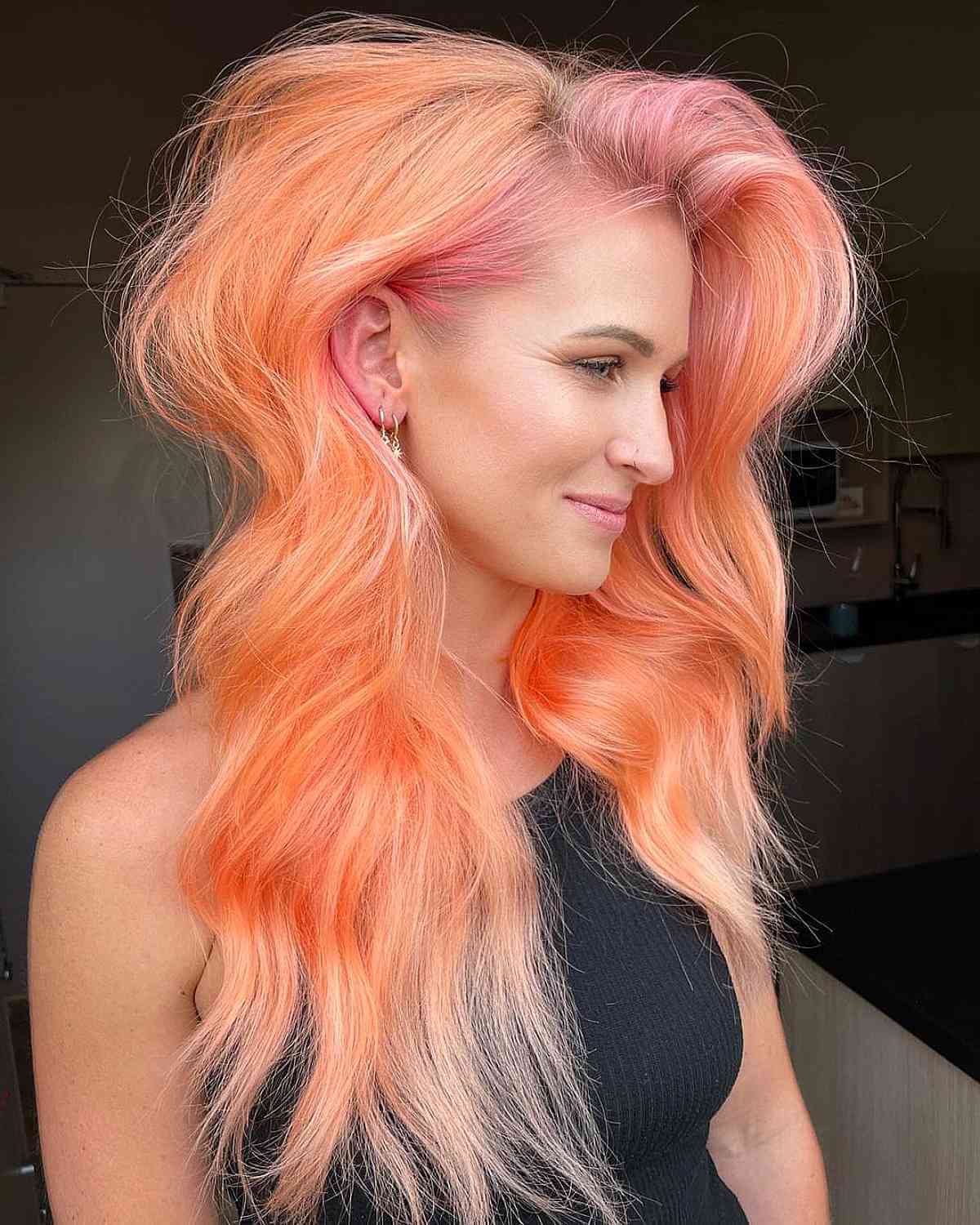
Pastels are easier to wear when they barely contrast. These long, voluminous layers are a soft peach, with a pink tint at the root and part, and the whole lot is swept heavily to one side with plenty of crown lift. The two shades sit so close in tone that the effect is gentle, not striped, and the ends have faded to a paler peach. Sweet, but grown-up.
- Best for: Pale blonde hair; those who want a soft, wearable pastel.
- Ask your stylist for: A pastel peach through the lengths with a soft pink root, blended so there is no line between the two.
- How to style it: Blow-dry with a large round brush for volume, then flip the hair to one side and set with a light hairspray.
- Upkeep: Pastels fade fast, so refresh every 3 to 4 weeks and use a peach color-depositing conditioner.
Split dye and color blocking
Split dye puts one color on each side of the part; color blocking uses bigger sections and even patterns. Both give a clean, graphic finish. For more pairings, our split dye hair ideas cover everything from black and blonde to neon.
9. The peach and lavender halves
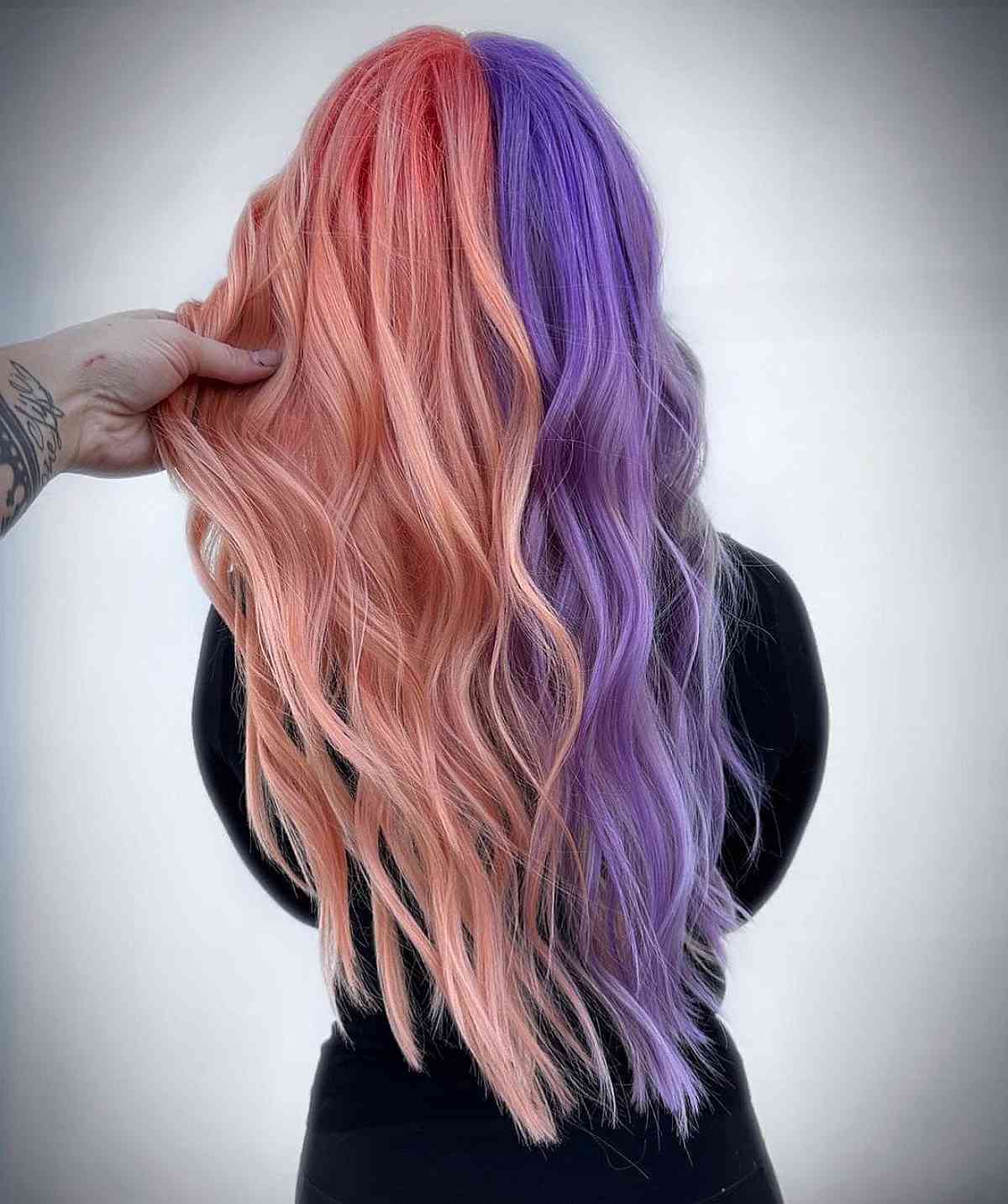
Turn around and the split does all the talking. The hair is divided cleanly down the middle: peach-pink on one side, lavender on the other. The long, loose waves share one texture, so the color line is the only thing separating the halves. Because both shades are soft pastels at a similar depth, the split looks playful rather than harsh. Clean sectioning at the crown is what makes it work.
- Best for: Pale blonde hair; anyone trying split dye for the first time.
- Ask your stylist for: A center split with pastel peach on one side and lavender on the other, sectioned cleanly from front to nape.
- How to style it: Wave with a 1-inch wand and part carefully down the center so the split stays crisp.
- Upkeep: Refresh both shades every 3 to 4 weeks; wash in cool water.
10. The pink and navy contrast

Light versus dark doesn’t get more dramatic than this. Pastel pink fills one side of the part and most of the lengths, while near-black navy sections run along the other side and through the back. The long, tousled waves mix the two at the ends, so the split softens as it travels down. Pink fades much faster than navy, so expect to refresh the light side more often.
- Best for: Lightened hair with good condition; those who want contrast with a soft side.
- Ask your stylist for: A split with pastel pink on one side and navy sections on the other, letting the two mix through the ends.
- How to style it: Curl loosely and leave the waves undone so the colors overlap.
- Upkeep: Pink every 3 to 4 weeks; navy lasts longer, so refresh every 6 to 8 weeks.