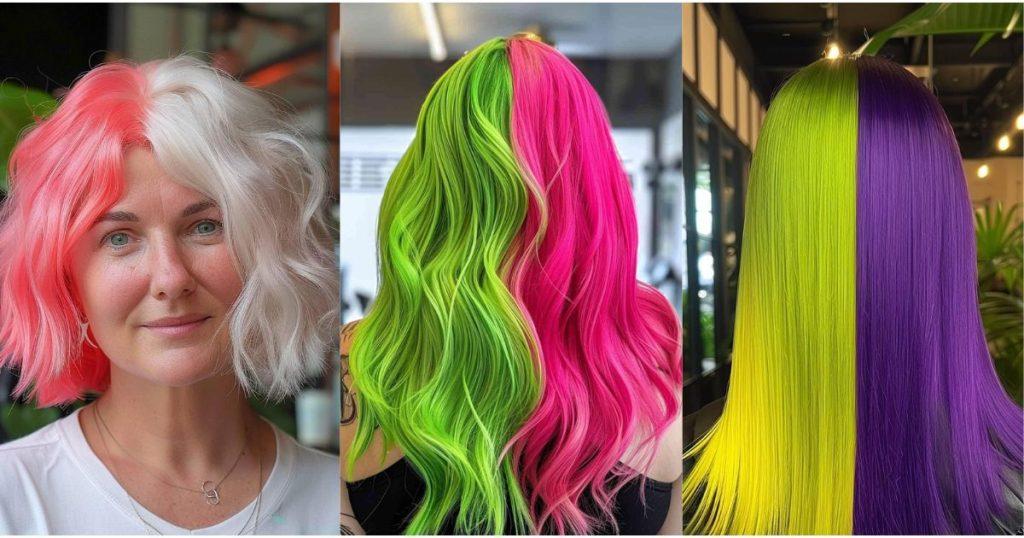
Can’t choose between two colors? Split dye says you don’t have to. Also called Gemini hair, it colors one half of your head in one shade and the other half in another, with a clean line running straight down the part. There is no blending and no fade. The contrast between the two sides is the entire point, and every time you flip your part you get a different look.
We gathered 22 true half-and-half splits and grouped them by how the two shades get along: sharp dark-and-light pairs, soft pastels, neon brights and tonal splits that stay in one color family. Each comes with who it suits, what to ask for, how to style it and how often it needs a top-up. If you want two colors that melt into each other instead, our guide to two-tone and multicolor hair covers fades and panels.
How to choose a split dye color pairing
Three decisions shape a split dye: how much contrast you want between the two halves, how much lightening your hair needs to get there, and where your part naturally falls. A center part gives a perfectly even split; a side part lets one color dominate the front view, which is handy if one shade is easier to wear at work than the other. If you like the drama of dark against light but not the full half-and-half, our black and blonde hair ideas show other ways to place the contrast.
| Starting hair | Split dye pairings that work best | What to avoid |
|---|---|---|
| Dark brown or black | Natural black on one side with red, blue, purple or blonde on the other | Two pastel sides, which need the whole head lifted to pale blonde |
| Medium brown | One deep shade (burgundy, violet) with one vivid shade (red, magenta) | Very pale pastels on fragile hair |
| Blonde or pre-lightened | Any pastel or neon pairing; platinum with one vivid color | Placing dark colors next to pale ones without a clean sectioning line, as dark pigment can bleed |
| Gray or white | Silver on one side with lilac, pink or coral on the other | Very warm, saturated colors that fade unevenly on coarse gray |
| Short bob | Bright, high-contrast pairs that read clearly at a short length | Subtle tonal pairs, which can look like uneven color on short hair |
Contrast: dark and light pairs give the cleanest, most graphic line; tonal pairs look softer and are easier to grow out. Bleeding: rinse each side separately with cool water, especially when one side is dark or very saturated, so the colors do not stain each other.
High-contrast dark and light splits
Dark against light gives the sharpest, most graphic split of all. These are usually easiest on naturally dark hair, because one side can stay close to your own color and only half your head meets the bleach.
1. The platinum and jet black split
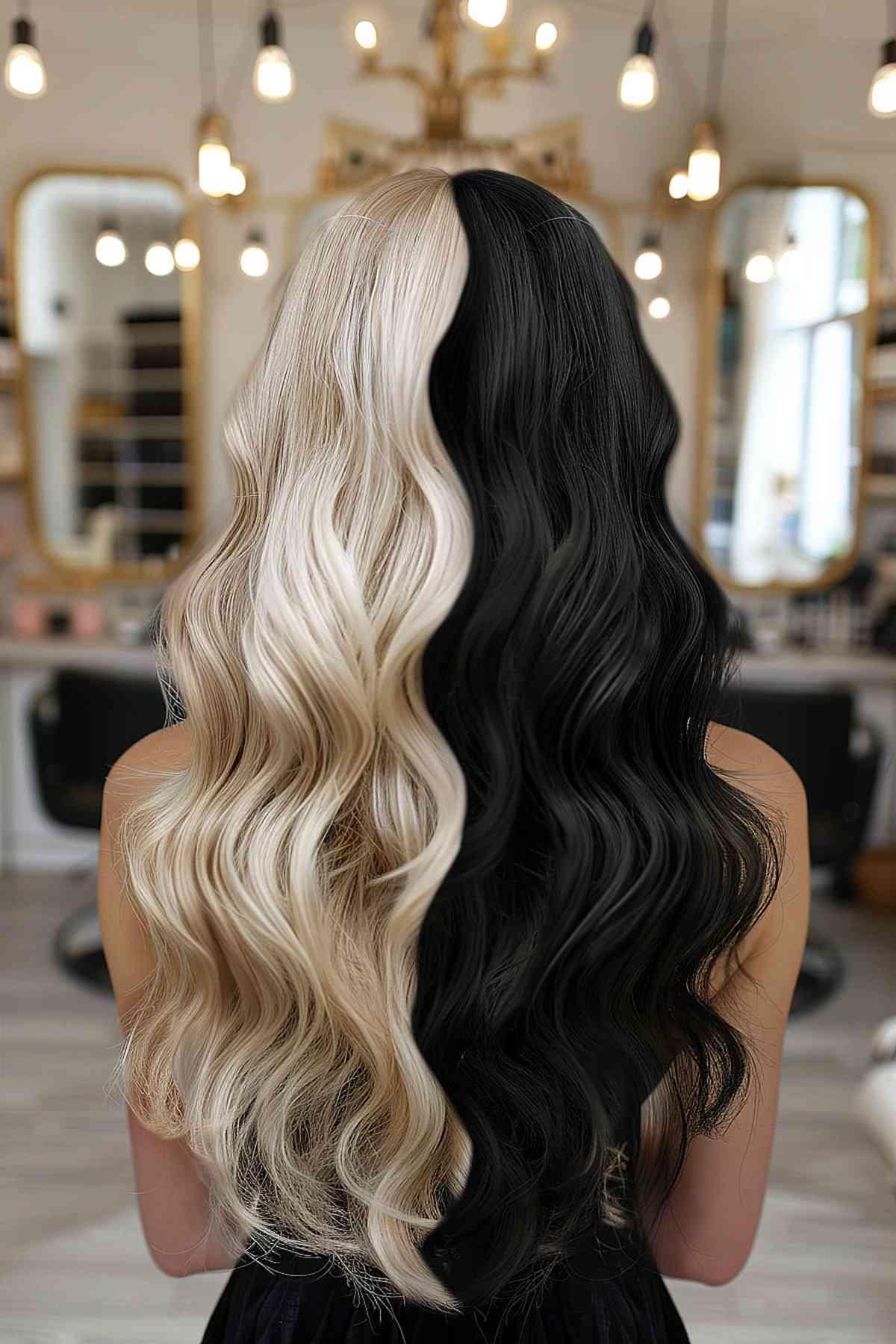
Light and shadow, with nothing in between. This long, wavy hair is divided straight down the center: one side lifted to a creamy platinum, the other glossy jet black. The waves fall at the same rhythm on both sides, which makes the contrast feel balanced rather than costume-like. Keeping the black side close to a natural dark base means only half the hair is bleached, so the platinum stays in better condition. Pure drama, done neatly.
- Best for: Dark hair that can handle lightening on one side; anyone who wants maximum contrast.
- Ask your stylist for: A center-part split dye with one side lifted to platinum and toned, and the other side colored jet black; clean sectioning at the part.
- How to style it: Curl in loose waves with a large barrel and keep the part sharp with a tail comb.
- Upkeep: Tone the platinum every 4 to 6 weeks; refresh roots every 6 to 8.
2. The glassy red and black split
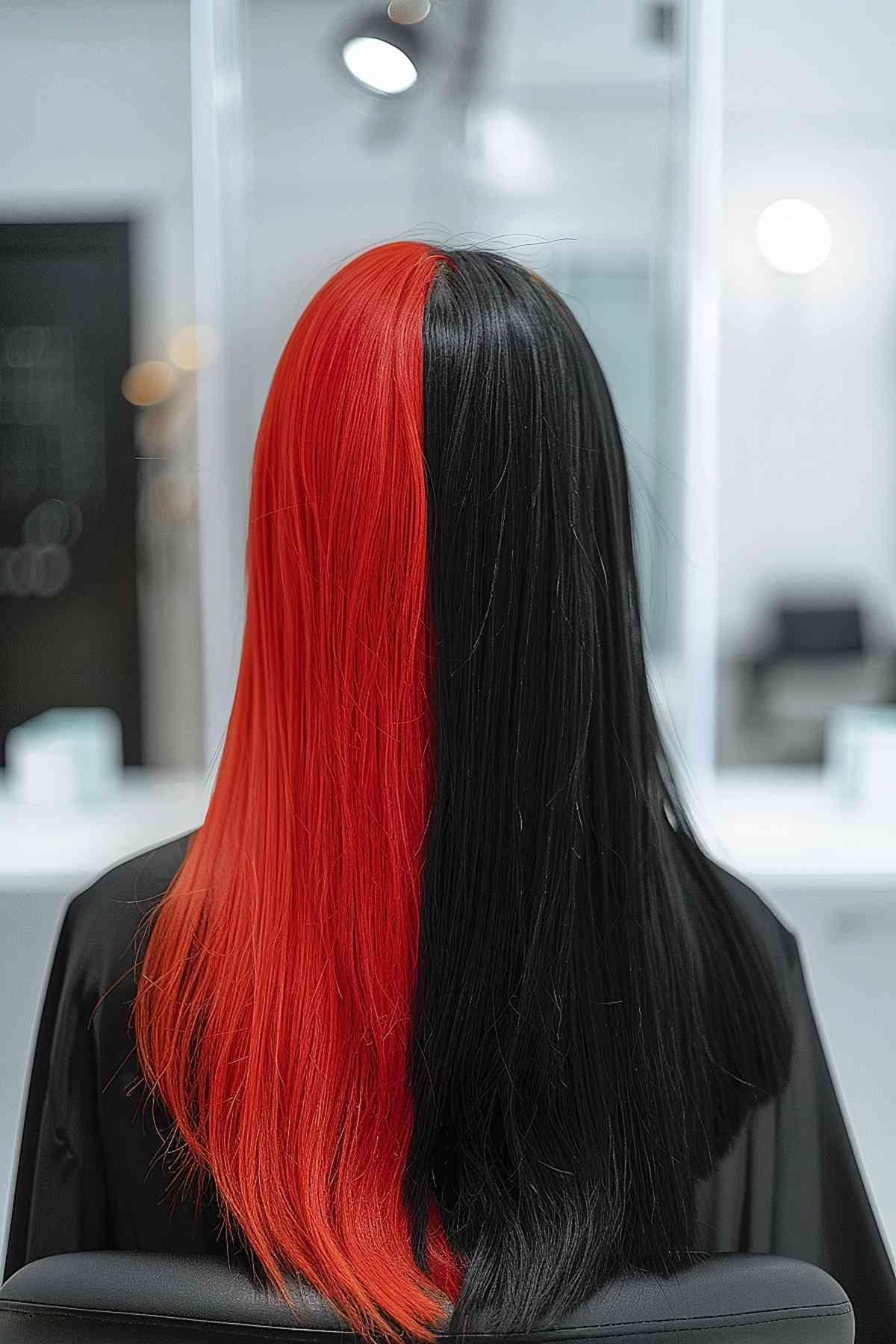
Want the sharpest line possible? Go straight. This long hair is flat-ironed to a glassy finish, with bright scarlet on one side and black on the other, and the split runs as cleanly as a ruler down the back of the head. Straight hair shows a split better than any texture because nothing breaks the edge. It suits dark hair perfectly, and our red and black hair color ideas show the same pairing as ombre and highlights.
- Best for: Dark brown or black hair; straight hair that holds a sleek finish.
- Ask your stylist for: A center-part split with the black side kept close to your natural color and the other side lightened and colored a bright red.
- How to style it: Flat-iron for a glassy finish and use a shine serum to make both colors reflect light.
- Upkeep: Red fades quickly; refresh every 4 to 6 weeks and wash in cool water.
3. The black and violet split
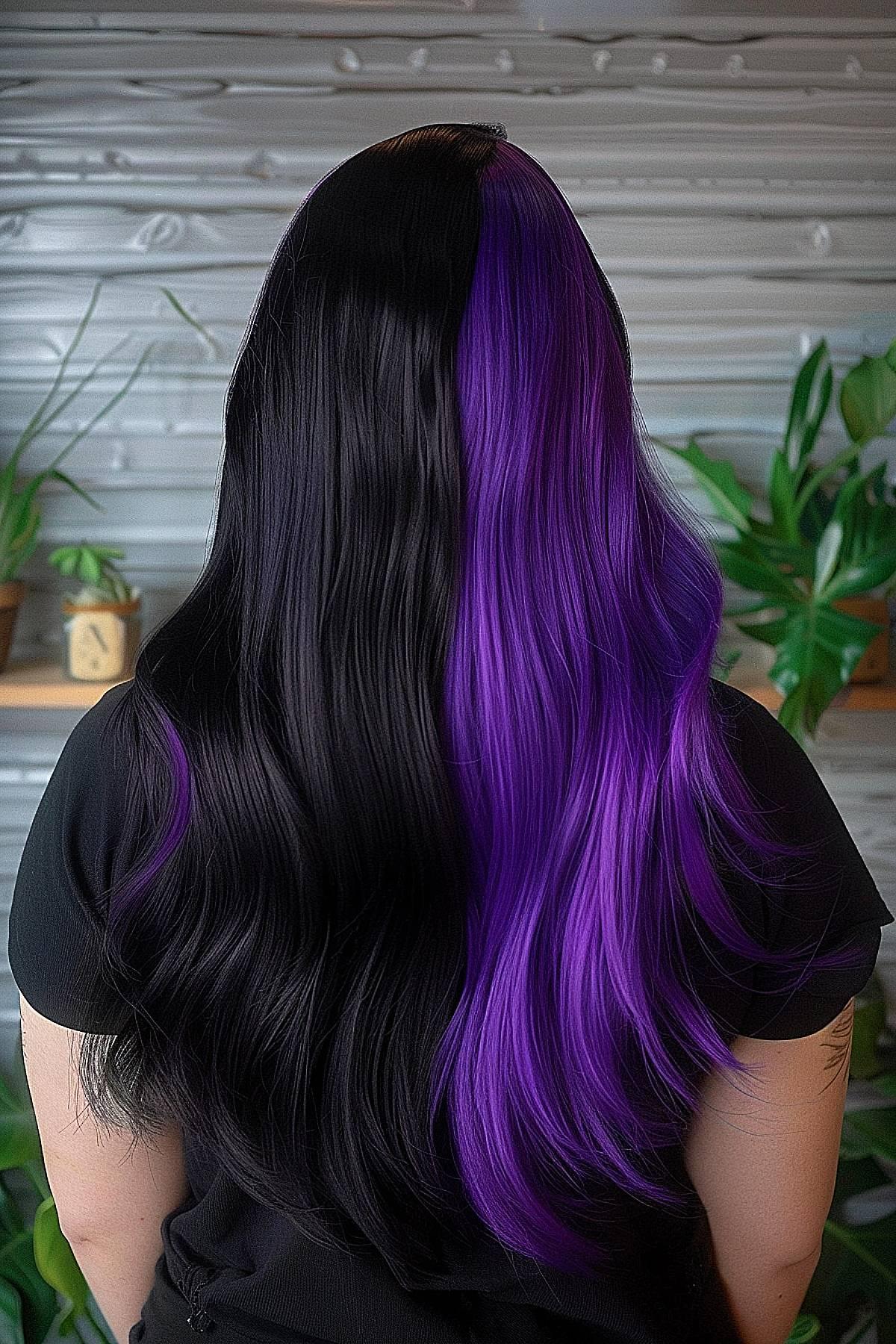
Moody without being gloomy. Here one half stays inky black and the other is a deep, saturated violet, both falling in soft waves down the back. Because violet sits close to black on the color wheel, the split looks bold up close but reads almost tonal from across the room. It is a great first split if you work somewhere conservative, and the violet only needs moderate lightening to show on dark hair.
- Best for: Dark hair; anyone who wants a bold color that still looks moody.
- Ask your stylist for: A center split with one side left black and the other lightened to about level 7 and colored deep violet.
- How to style it: Wave loosely with a curling wand and finish with shine spray.
- Upkeep: Refresh the violet every 4 to 6 weeks with a color-depositing conditioner in between.
4. The electric blue and black split
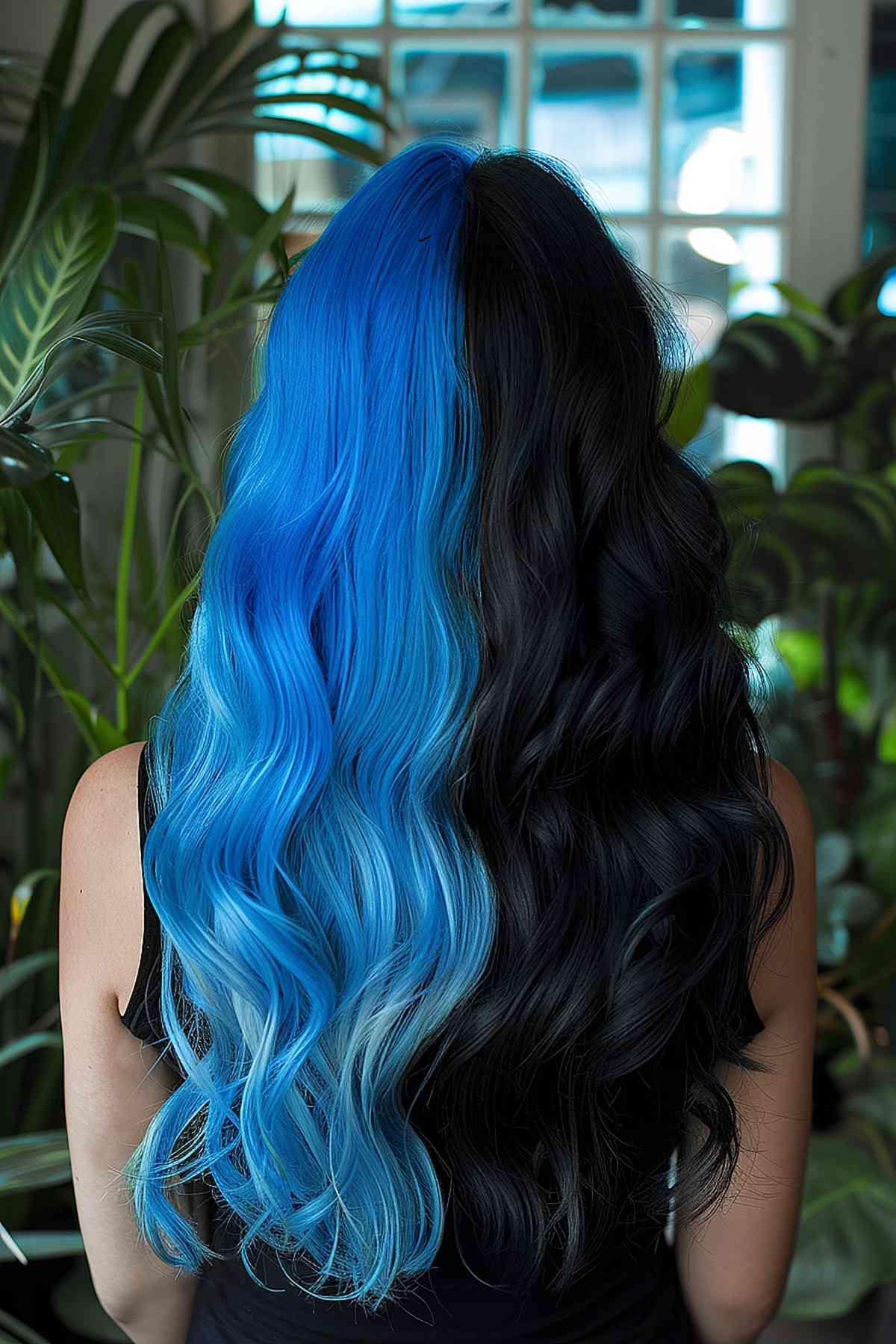
If blue is your color, this lets you wear it without committing your whole head. Electric blue fills one side of these long waves while the other stays a natural-looking black. Toward the ends the blue softens a little lighter, giving it a hint of movement. The black half anchors the look and keeps it wearable, and when the blue fades you are left with a soft denim tone rather than a mess.
- Best for: Dark brown or black hair; cool skin tones.
- Ask your stylist for: A center split, black on one side and electric blue over lightened hair on the other.
- How to style it: Curl with a large wand and brush through for soft waves.
- Upkeep: Blue fades within 3 to 6 weeks; refresh regularly and use cold water.
5. The royal purple and silver split
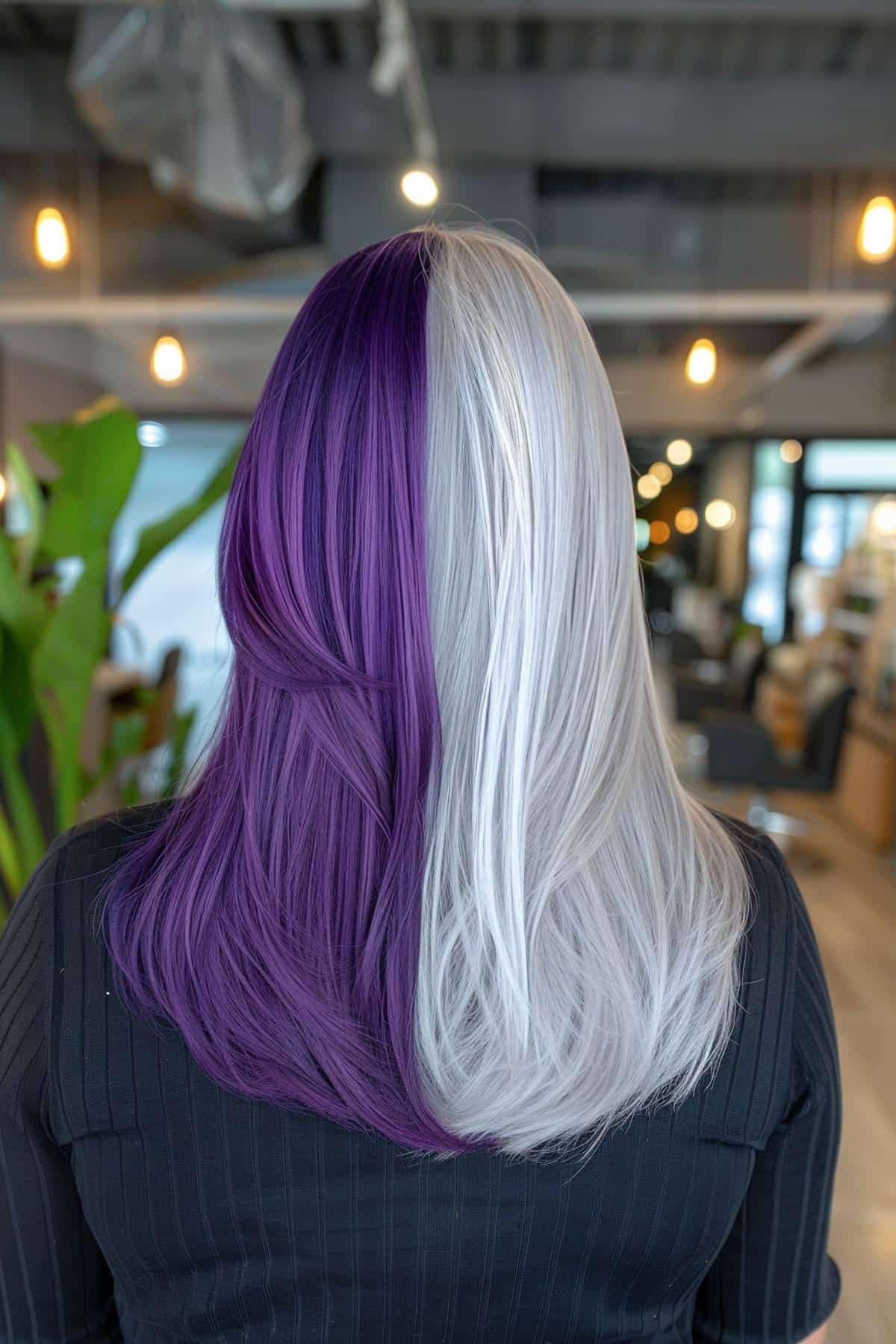
Split dye can be elegant, and this one proves it. Soft layers fall just past the shoulders, with royal purple on one side and a bright, cool silver on the other. The layers flick slightly at the ends, so both colors catch the light. Silver and purple share a cool undertone, which is why the pairing looks refined instead of loud. A good choice if you want color with a polished, grown-up edge.
- Best for: Lightened hair; cool skin tones; anyone who likes a more refined split.
- Ask your stylist for: A center split with one side toned silver and the other side colored royal purple; soft layers at shoulder length.
- How to style it: Blow-dry smooth with a round brush and add shine serum.
- Upkeep: Silver needs toning every 4 weeks; purple every 4 to 6.
Pastel split dye
Pastel pairs are the softer, dreamier side of split dye. They need the hair lifted to a very pale blonde first and they fade faster than deep shades, so plan on regular top-ups. For single-shade ideas in the same soft palette, see our pastel hair colors sorted by shade.
6. The cotton candy blue and pink split
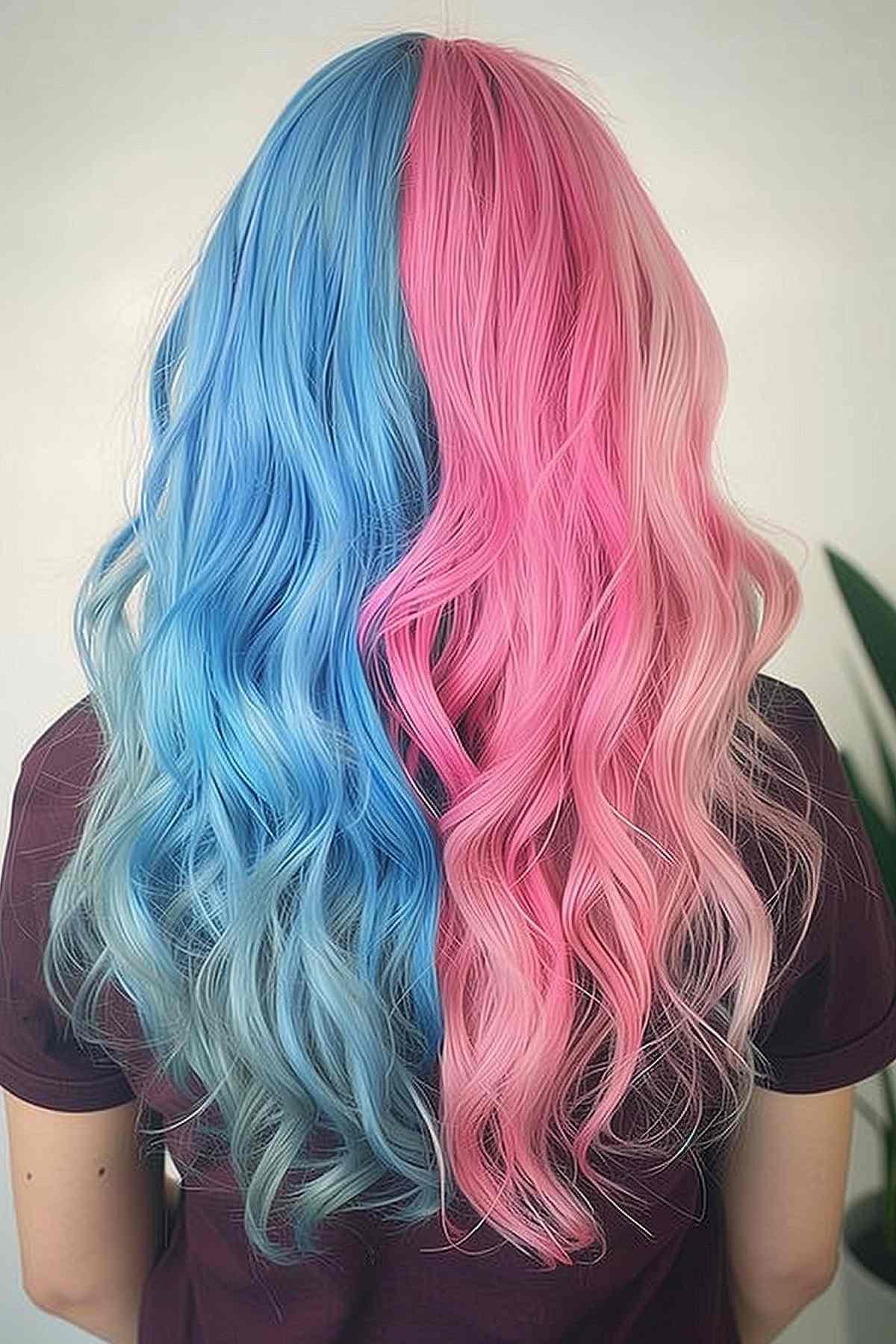
Sweet, soft and impossible to miss. These long, loose waves are split right down the center into baby blue and candy pink, both over hair lifted to a very pale blonde. The pastel blue fades slightly toward the ends, which keeps it airy. Pairing two pastels of the same lightness makes the split look playful rather than harsh. For more shades in this mood, browse our cotton candy hair colors.
- Best for: Pre-lightened or naturally very light hair; fair skin.
- Ask your stylist for: A center split with pastel blue on one side and pastel pink on the other, over hair lifted to a pale level 9 or 10.
- How to style it: Curl loosely with a wand and use a light leave-in to keep the hair soft.
- Upkeep: Pastels fade in 2 to 4 weeks; use color-depositing conditioner weekly.
7. The rose and platinum split
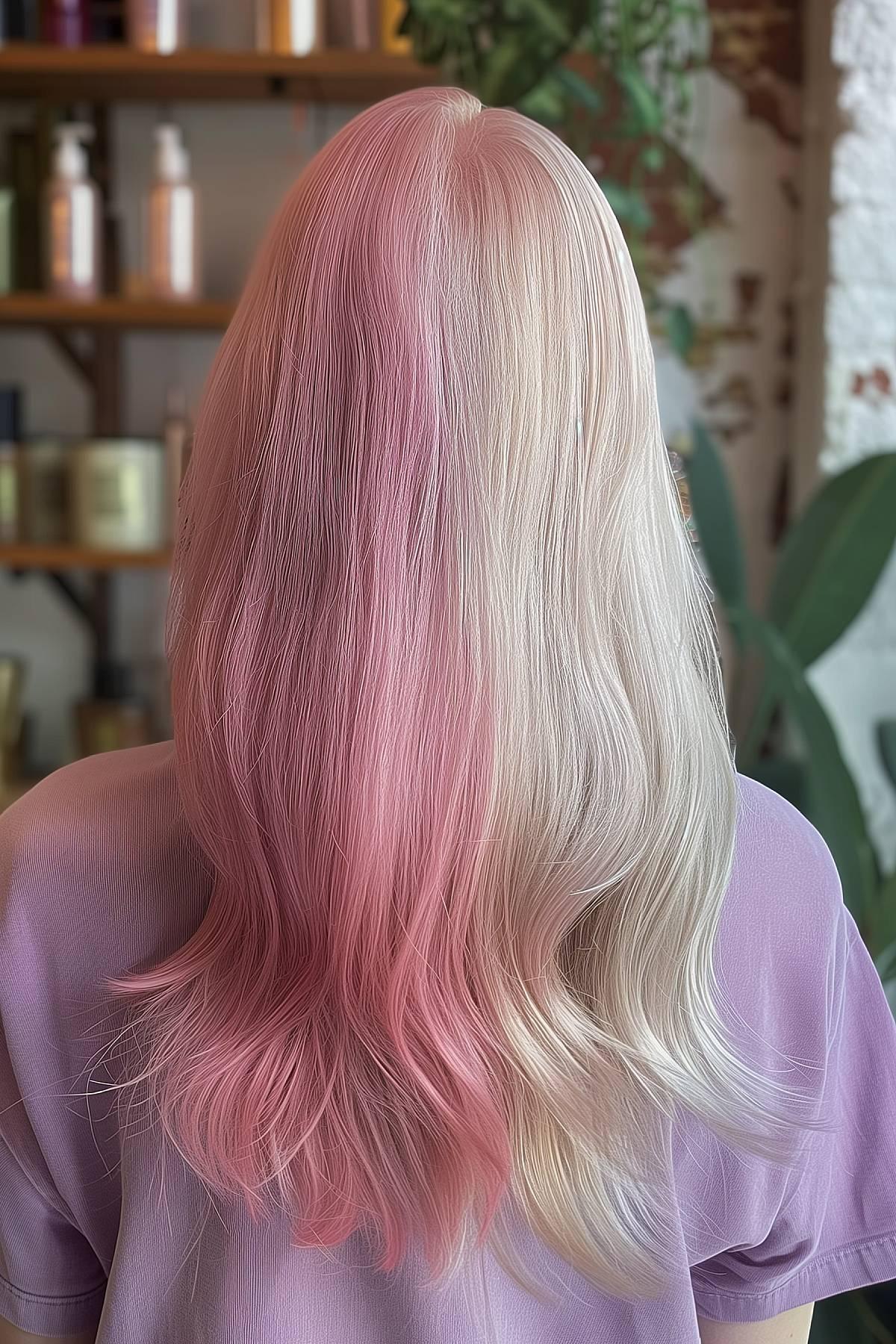
Nervous about split dye? Start here. This long, straight-to-wavy hair has a soft rose pink on one side and a pale platinum blonde on the other, and the two shades are close enough in depth that the line is gentle. When the pink fades, it simply turns a pale blush, so you are never left with a jarring half. It is the most forgiving way to try the trend.
- Best for: Blonde or lightened hair; anyone trying split dye for the first time.
- Ask your stylist for: A center split with one side toned platinum and the other side colored a soft rose pink.
- How to style it: Smooth with a paddle brush and bend the ends with a flat iron.
- Upkeep: Refresh the pink every 3 to 4 weeks; tone the platinum every 4 to 6.
8. The mint and lilac split
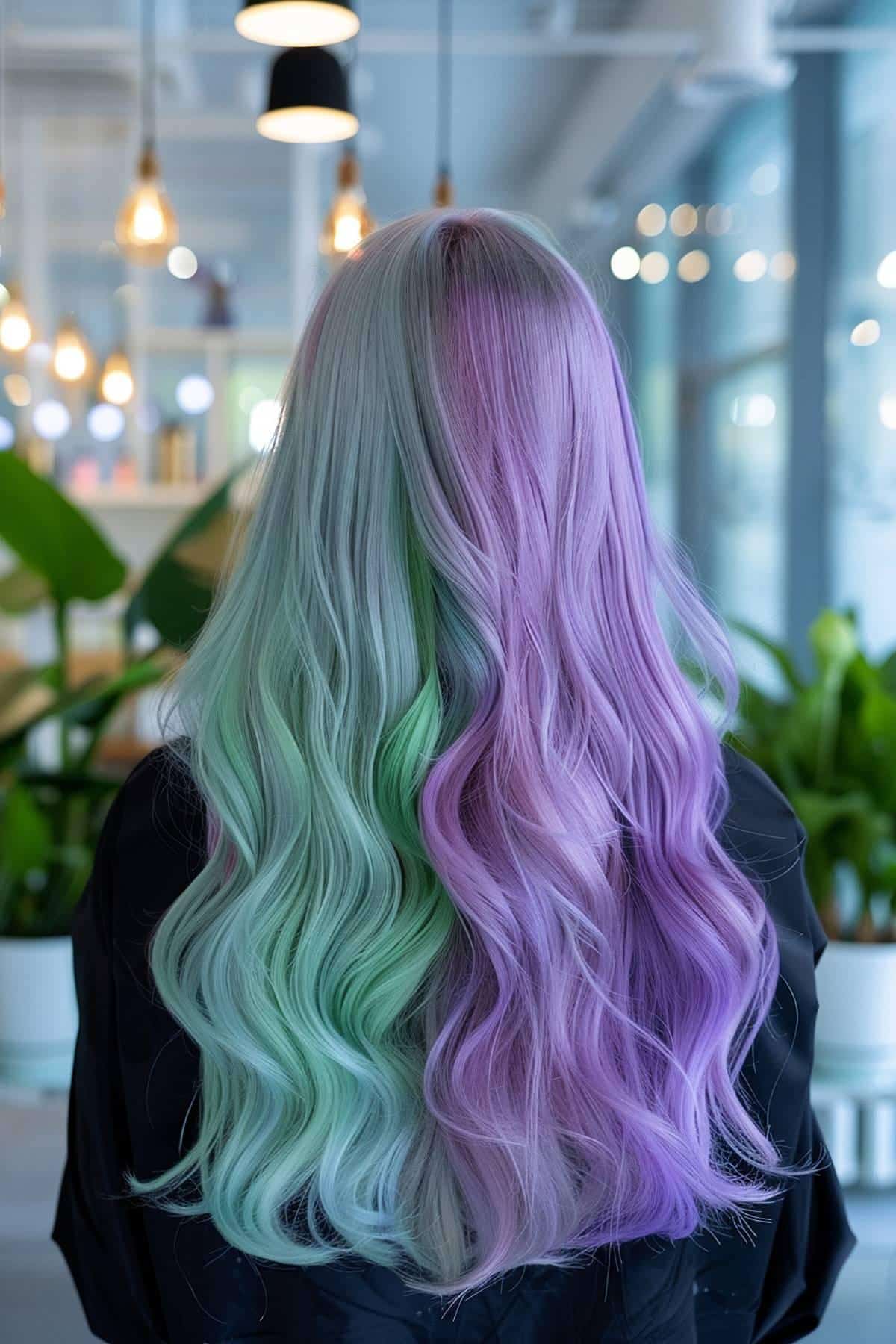
Ice cream colors, grown-up execution. Long waves are split into a frosty mint on one side and a soft lilac on the other, with a pale silvery root showing at the part. Both shades sit at the same pastel depth, so neither side overpowers the other. Cool pastels like these flatter cool and neutral skin tones and look especially fresh in natural daylight.
- Best for: Pre-lightened hair; cool or neutral skin tones.
- Ask your stylist for: A center split with mint green on one side and lilac on the other, over very pale lightened hair.
- How to style it: Curl with a large wand and brush out lightly.
- Upkeep: Pastels fade fast; refresh every 3 to 4 weeks.
9. The icy blue and peach split with bangs

Here’s the front view, and the bangs are where it gets clever. Long, straight hair is split into a silvery icy blue on one side and a warm peach pink on the other, and the split carries straight through the wispy fringe. The blue deepens toward the ends while the peach stays soft. Carrying the split through the bangs means your face is framed by both colors at once, which looks deliberate and very sweet.
- Best for: Lightened hair; fair to light skin; anyone who wears bangs.
- Ask your stylist for: A center split with icy blue on one side and peach pink on the other, carrying the split through wispy bangs.
- How to style it: Blow-dry straight and keep the bangs smooth with a flat brush.
- Upkeep: Refresh every 3 to 4 weeks; tone regularly.
10. The baby pink and lemon split

Sunny side up. This shoulder-length cut wears baby pink on one side and bright lemon yellow on the other, split along a natural side part so the pink takes over most of the front. Soft layers flip out around the collarbone. Using a side part lets you choose which color leads, so you can tuck the bolder yellow away on a quieter day. Fun, warm and easy to wear.
- Best for: Lightened hair; warm or neutral skin tones.
- Ask your stylist for: A split along your natural part, with baby pink on one side and lemon yellow on the other; soft shoulder-length layers.
- How to style it: Rough-dry and add texture spray for a piecey finish.
- Upkeep: Refresh every 3 to 4 weeks.