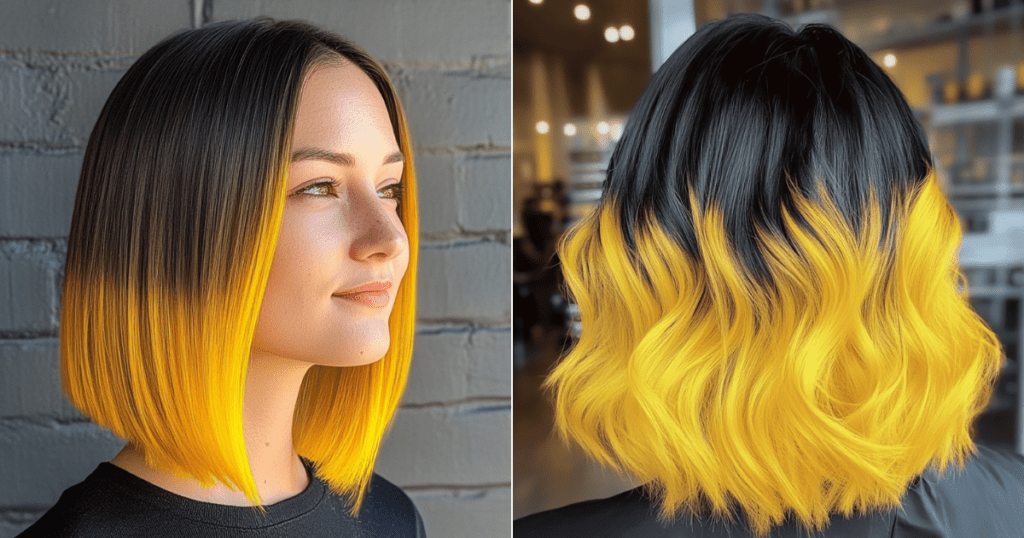
Yellow is the shade most colorists spend their careers trying to tone out, which is exactly why it looks so deliberate when it is put back in on purpose. Done well, it reads as sunshine rather than brassiness: a saturated marigold, a sharp lemon, a mustard ribbon that glows against brown. The difference between the two comes down to how clean the lightened base is and how evenly the dye goes on.
These 22 looks cover the whole spectrum, from warm golden yellows that sit close to orange hair colors to neon chartreuse, lemon dip-dyes and yellow worked into pink, red and black. For each one you’ll find who it suits, what to say in the salon, how to style it at home and how often you’ll need to top up the color.
How to choose a yellow hair color
The deciding factor is how light your hair can safely go. A true lemon or canary needs a pale, even base, roughly the color of the inside of a banana peel. Deeper golden and marigold yellows are more forgiving because they can sit over a slightly warmer lift, and they fade more gracefully.
| Hair type | Yellow shades that work best | What to avoid |
|---|---|---|
| Dark brown or black | Marigold or mustard on the mid-lengths and ends, with your natural color kept as a shadow root | All-over lemon, which needs heavy lightening from the scalp |
| Light brown or dark blonde | Golden yellow balayage or mustard highlights over a brown base | Pastel yellow, which turns muddy over an uneven lift |
| Pale blonde or platinum | Lemon, canary or neon yellow, all-over or as a dip-dye | Skipping a clarifying wash, as old toner can tint the yellow green |
| Gray or silver | A yellow dip-dye on the ends with the silver left on top | Applying yellow straight onto unlightened gray, which grabs unevenly |
| Fine or fragile | Yellow on the ends only, or a few face-framing pieces | Repeated full-head bleaching to reach a pale base |
| Curly or coily | Golden yellow on the ends, applied curl by curl | High-lift bleach on dry curls without a bond-building treatment |
Warm or cool: golden and marigold yellows lean warm and blend easily with brown roots, while lemon and chartreuse lean cool and look sharper next to platinum or silver. Placement: if you’re unsure, start with yellow on the ends as an ombre hair color; it grows out with no visible line and is easy to cut off.
Golden, marigold and mustard yellows
The warmest end of the yellow family sits closest to honey and copper, so it flatters a brown root and fades without turning stark. These seven lean gold, saffron and mustard.
1. The copper-rooted marigold waves
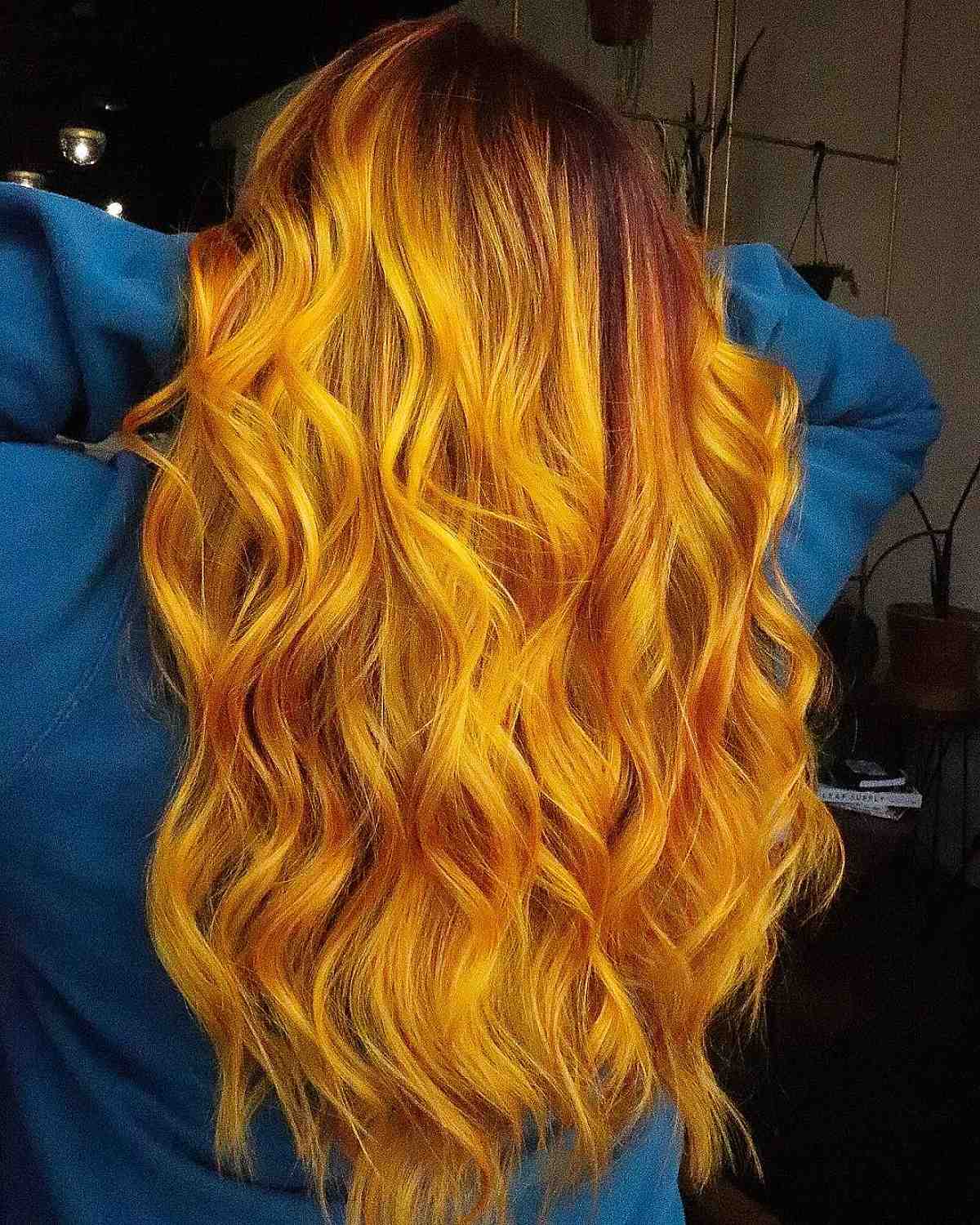
Picture a field of marigolds at dusk and you have the mood of this one. A copper-red shadow sits at the crown, then the color brightens into deep saturated gold through hair that falls well past the shoulder blades. Loose, uneven waves catch the light on their outer curves, so the yellow looks layered even though it is one family of shades. The warm root is the trick: it bridges the gap between dark regrowth and bright lengths.
- Best for: Long, medium to thick hair with a light brown or red natural base.
- Ask your stylist for: A copper root smudge melting into a saturated marigold yellow on pre-lightened mid-lengths and ends.
- How to style it: Wrap random sections around a 1.25-inch curling iron, leave the ends out and rake the waves apart with your fingers.
- Upkeep: Refresh the yellow every 4 to 6 weeks; root smudge every 10 to 12 weeks.
2. The burgundy-rooted saffron lob
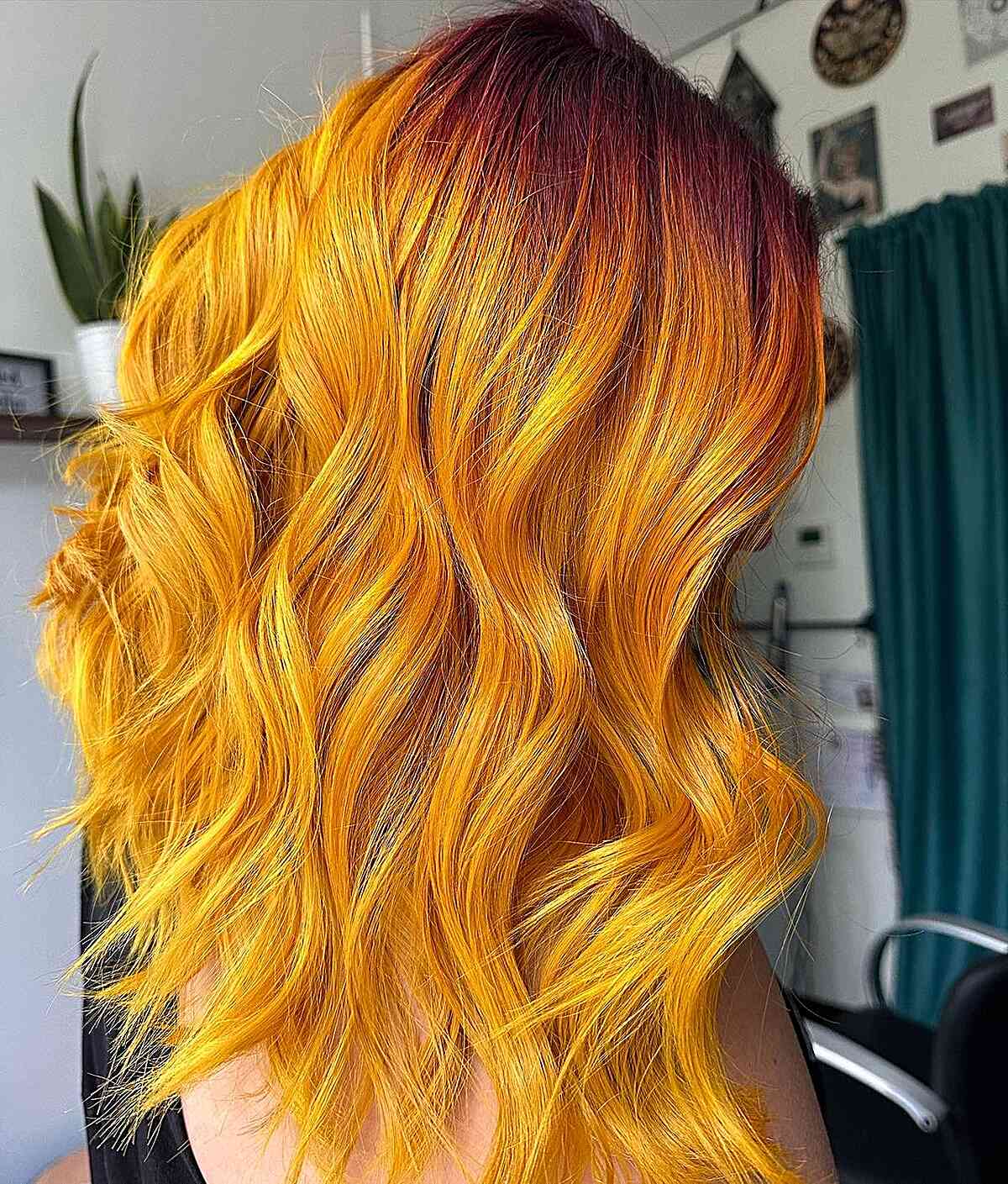
Want yellow that still feels rich rather than playful? Here a dark burgundy root bleeds into a saffron gold that turns almost orange in the shadows of each wave. The length stops below the collarbone, and big, loose bends give it body from the side. Because the base color is so deep, the yellow reads like spice rather than highlighter. Moody at the top, sunny at the ends.
- Best for: Thick, wavy hair; anyone with a red or burgundy color they want to brighten.
- Ask your stylist for: A burgundy root shadow blended into saffron yellow on the lengths, with soft layers below the collarbone.
- How to style it: Scrunch in a light curl cream and diffuse, or wave with a large barrel and brush through lightly.
- Upkeep: Gloss the yellow every 4 to 6 weeks; trim every 8 to 10 weeks.
3. The black-root golden curls
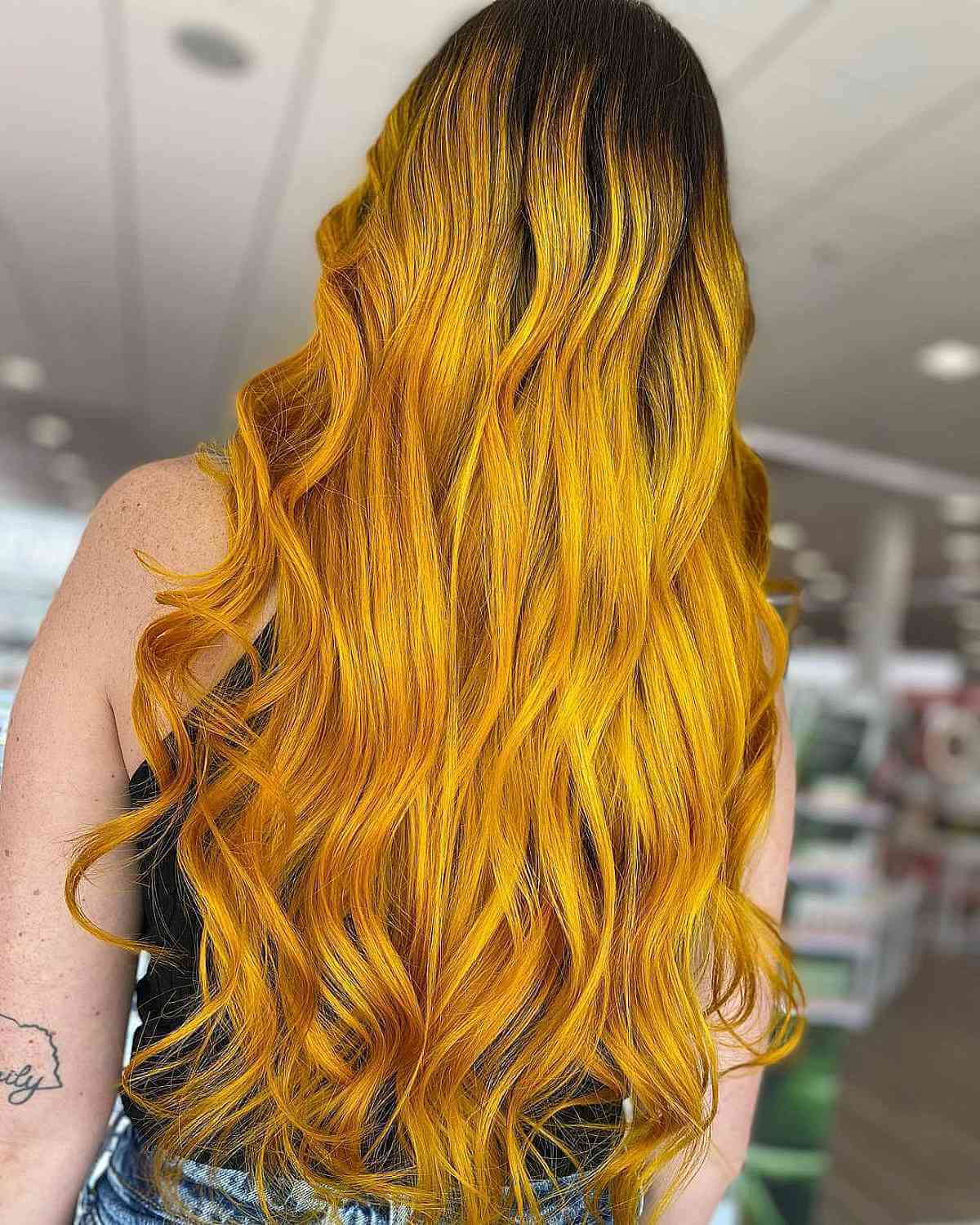
For anyone with long dark hair who has been wondering whether yellow could work: it can, and this is the proof. Black roots stay untouched for the first few inches, then the hair turns to a deep golden yellow that runs all the way to the waist. Loose spiral curls keep the color moving, with lighter yellow on the curl edges and warmer gold tucked underneath. Leaving the root dark means far less bleach near the scalp.
- Best for: Very long, dark hair; anyone who wants low-commitment regrowth.
- Ask your stylist for: A lived-in black shadow root with golden yellow balayage from the cheekbones down, kept warm rather than lemony.
- How to style it: Set loose curls with a 1-inch wand on dry hair, then shake them out and finish with a shine spray.
- Upkeep: Top up the yellow every 5 to 6 weeks; the root can go 3 to 4 months.
4. The tangerine-gold curtain fringe
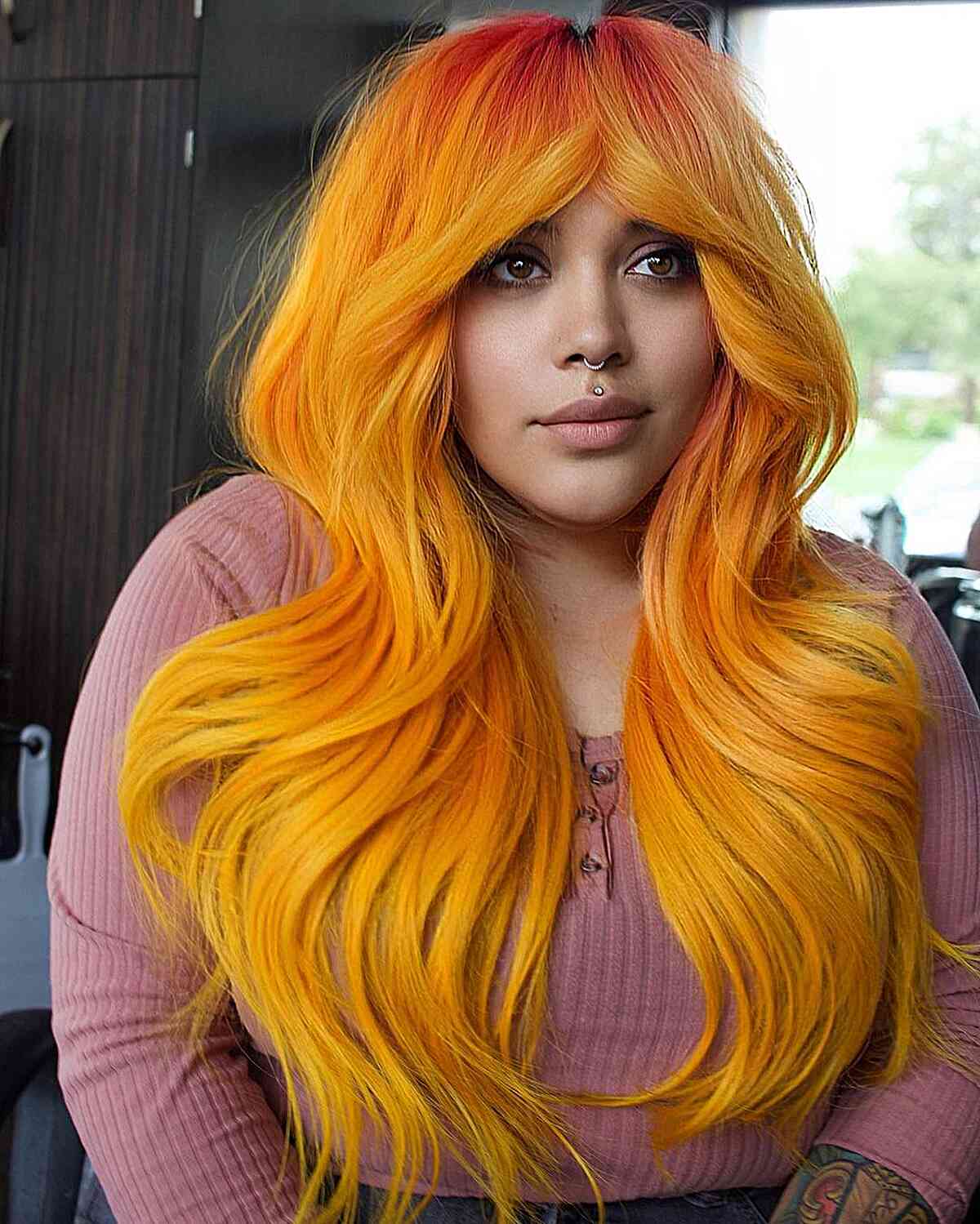
Turn the warmth up past gold and you land here: a tangerine-yellow blend with a red flush at the parting. The cut does just as much work as the color, with curtain bangs that part at the center and long face-framing layers that swing past the chest. Where the layers overlap, the shades stack into deeper orange; on the outer edges they glow yellow. It is a warm, saturated choice for anyone who already loves wearing bright color.
- Best for: Long, thick hair; anyone who wants a fringe and a vivid shade in one change.
- Ask your stylist for: Curtain bangs and long face-framing layers, with a red root melting into tangerine and golden yellow lengths.
- How to style it: Blow-dry the bangs over a medium round brush, then bend the lengths away from the face with a large barrel.
- Upkeep: Bang trims every 4 to 6 weeks; refresh the color every 4 to 5 weeks.
5. The mustard layers over black
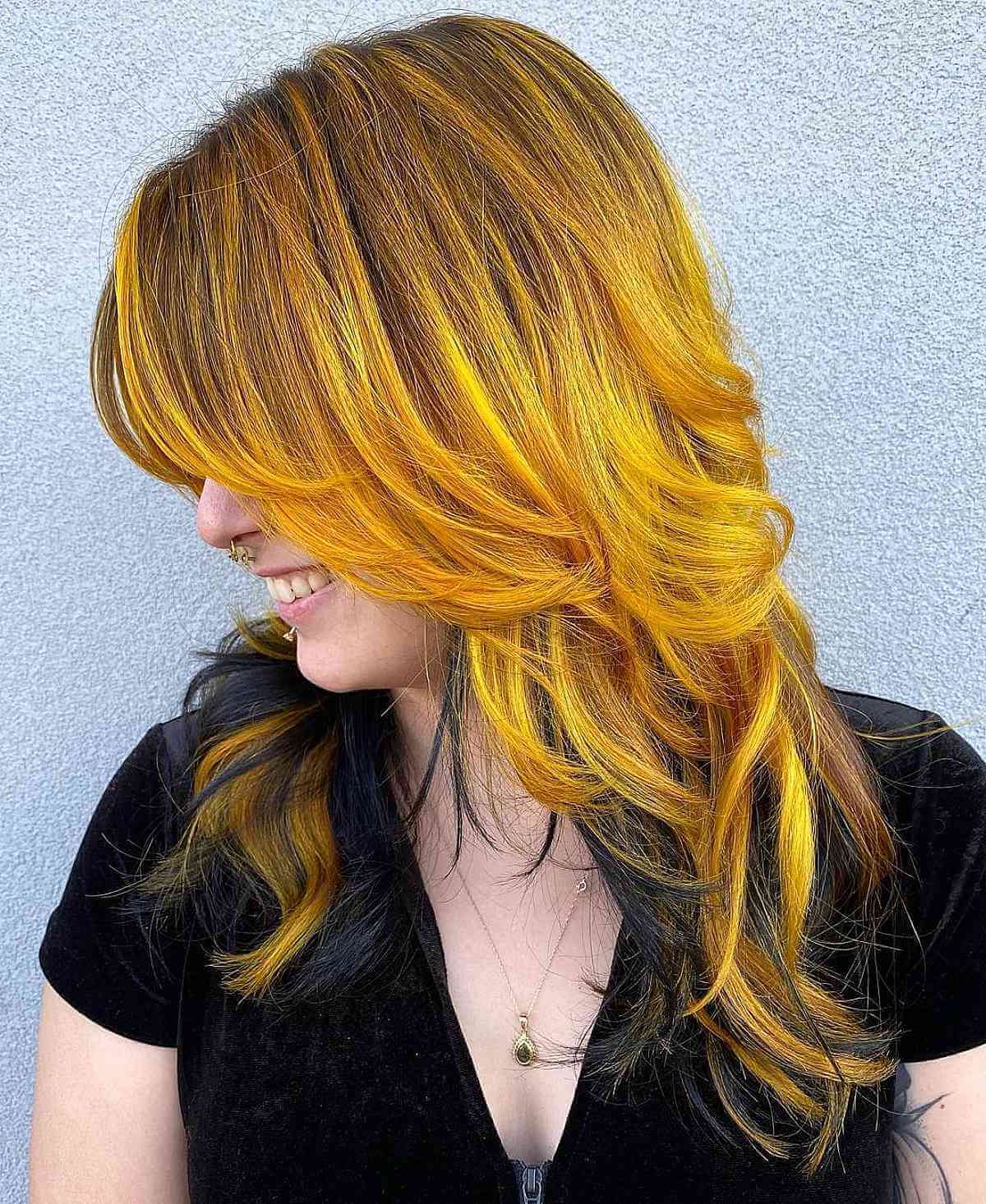
If you like your color with an edge, look at what happens underneath. The top layers are a burnished mustard yellow, cut into a long side-swept fringe that falls across one eye, while the underlayers stay jet black and peek out at the shoulders. Long, choppy layers make the two shades interlock as the hair moves. It’s a smart way to wear yellow with half the bleaching, since only the top sections are lightened.
- Best for: Medium to thick hair with a dark base; anyone who wants color that shifts with movement.
- Ask your stylist for: Mustard yellow on the top sections only, black left underneath, with long choppy layers and a long side fringe.
- How to style it: Rough-dry, then flip the fringe to one side and twist a little texture paste through the layers.
- Upkeep: Refresh the mustard every 5 to 6 weeks; layer trim every 8 weeks.
6. The brunette with mustard ribbons
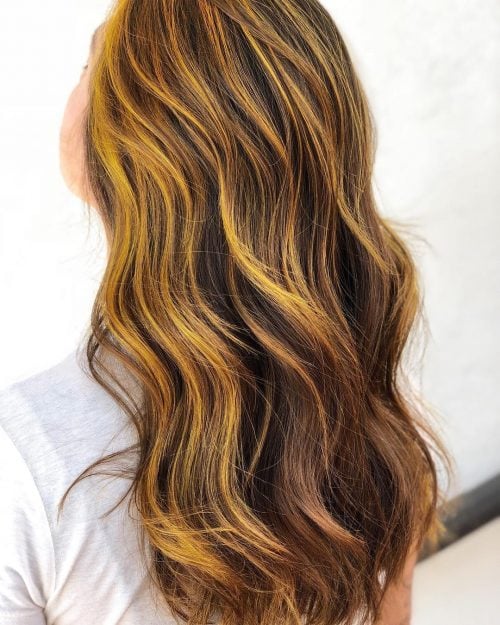
Not ready to go fully yellow? Start here. The base is a warm medium brown, and mustard-gold ribbons are woven through it in fine to medium pieces, brightest on the outer waves. The pattern is soft enough that from a distance it reads as sun-warmed brunette, and only up close do you notice how yellow the pieces are. Long, loose waves help the highlights spiral rather than sit as stripes.
- Best for: Brown hair of any density; first-timers who want a subtle step into yellow.
- Ask your stylist for: Fine to medium hand-painted highlights toned to mustard yellow, kept off the root.
- How to style it: Wave with a 1.5-inch iron, alternating direction, then brush through for a softer finish.
- Upkeep: Toner or gloss every 6 to 8 weeks; highlights every 3 to 4 months.
7. The butter-yellow wavy lob
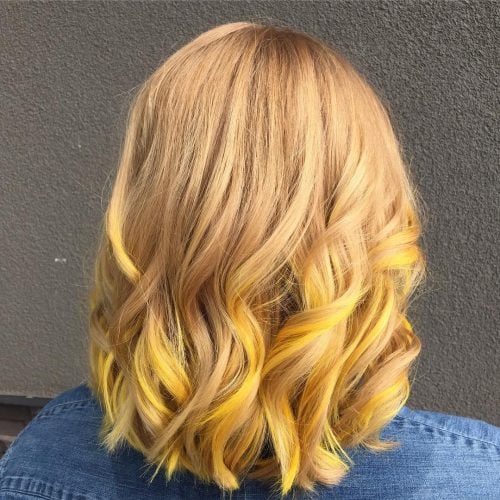
Somewhere between honey blonde and true yellow sits this buttery shade. It is all-over and even, with slightly brighter yellow pieces on the ends, cut to just past the shoulders with soft waves that bend outward at the tips. Because the tone is so close to blonde, it works as an easy entry point if you already wear golden hair. Think of it as blonde with the saturation turned up.
- Best for: Light brown to blonde hair; anyone who already wears warm blonde and wants more color.
- Ask your stylist for: An all-over golden butter yellow with brighter yellow on the ends, on a shoulder-length lob with soft layers.
- How to style it: Air-dry with a wave spray, then touch up a few pieces with a 1.25-inch iron.
- Upkeep: Gloss every 6 weeks; trim every 8 weeks. See our honey blonde hair ideas for softer versions.
Lemon, canary and neon yellows
These are the loud ones. Each needs a very pale base, and most are paired with a short or shaped cut that shows the color off.
8. The canary micro-fringe mullet
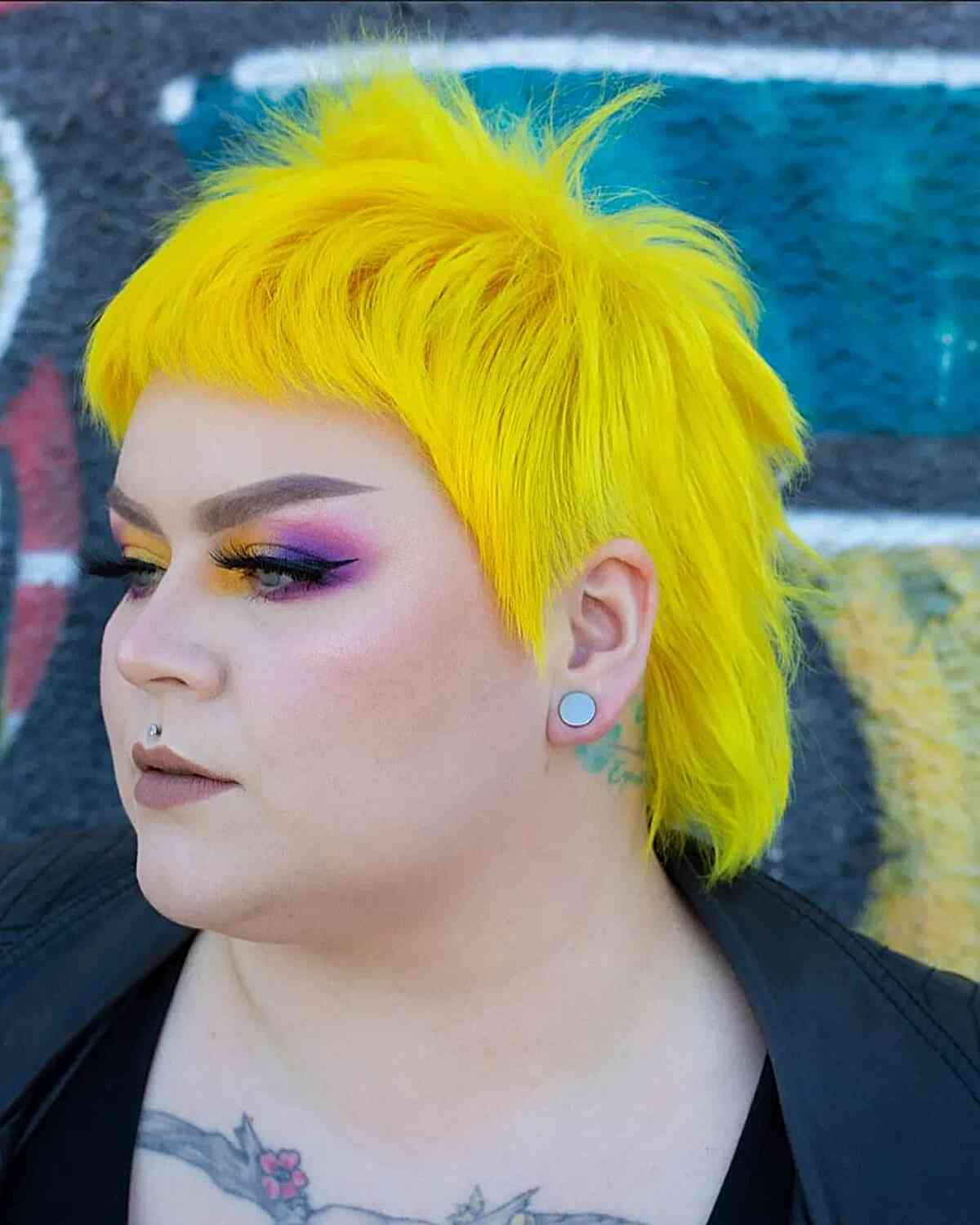
Bold color, bold cut, no half measures. This canary yellow is applied evenly from root to tip over a very pale base, so there is no dark regrowth anywhere. Short choppy bangs sit high on the forehead, the sides are cut close and the back trails into longer, wispy ends at the neck. The micro fringe keeps the shape graphic, and the shade is bright enough to clash happily with purple eyeshadow.
- Best for: Straight to slightly wavy hair; anyone confident with vivid, high-maintenance color.
- Ask your stylist for: A short mullet with choppy micro bangs and wispy length at the nape, colored in canary yellow over a level 10 base.
- How to style it: Blast-dry the top with your fingers for lift, then pinch the back ends with a little wax.
- Upkeep: Root touch-up every 4 to 6 weeks; re-dye every 3 to 4 weeks to keep it bright.
9. The lemon crop with a shaved design
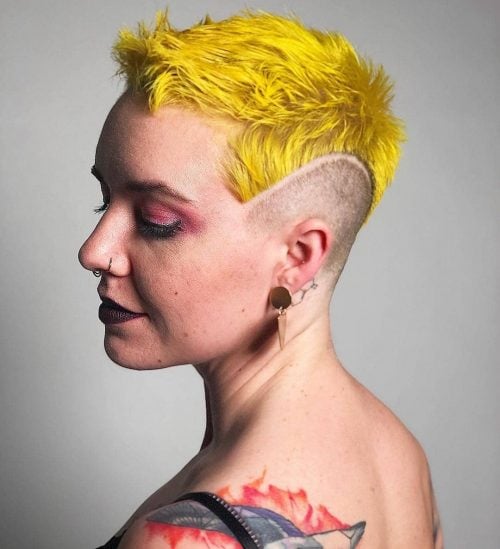
Short hair is where yellow gets the least time to fade. This cropped pixie is dyed a clean lemon and spiked forward at the top, while the side is clipper-shaved close with a curved line etched above the ear. The contrast between the bright top and the bare skin of the undercut makes the yellow look even sharper. Every cut is basically a color refresh, too.
- Best for: Thick, straight hair; anyone who likes very short, low-styling hair.
- Ask your stylist for: A short textured pixie with a clipper-shaved side and a curved line design, colored lemon yellow on the top.
- How to style it: Rub a pea-sized amount of matte paste between your palms and push the top forward and up.
- Upkeep: Clean up the undercut every 2 to 3 weeks; trim and recolor every 4 weeks.
10. The copper-to-yellow shag mullet
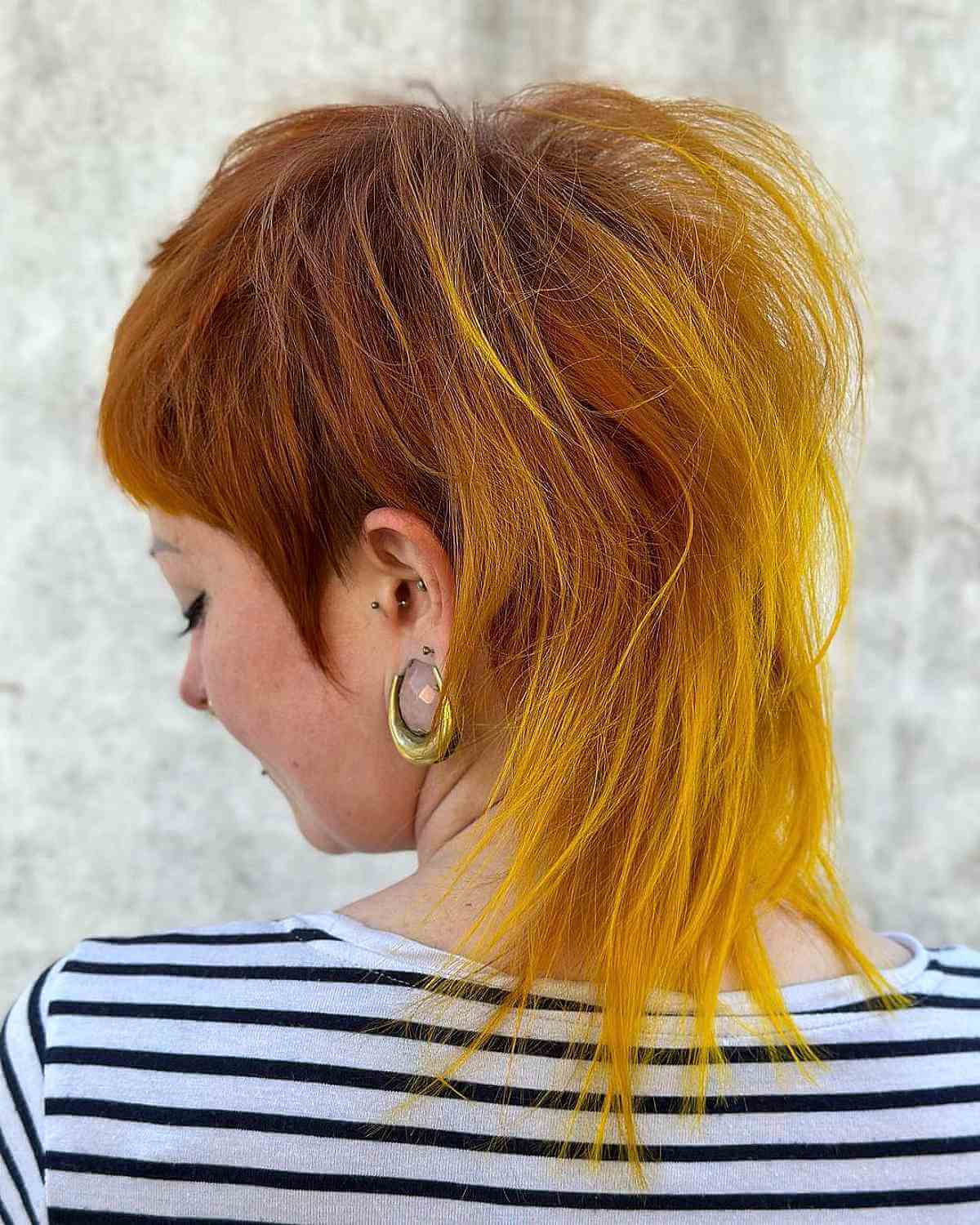
Seen from the side, this cut tells the whole color story. A copper-orange crown is cut short and choppy, then the back drops into long, razored pieces that fade to bright yellow at the tips around the shoulders. Fine, separate ends let the yellow look almost translucent against a striped top. Putting the brightest shade on the longest pieces turns the length into a focal point.
- Best for: Fine to medium straight hair; anyone who likes a grown-out, undone shape.
- Ask your stylist for: A shaggy mullet with a short choppy crown and long razored ends, with copper on top fading to yellow at the tips.
- How to style it: Mist with sea salt spray and rough-dry, then twist a few back pieces to separate them.
- Upkeep: Trim every 6 to 8 weeks; refresh the yellow ends every 4 to 6 weeks.